
Bar Pulls vs Bow Pulls vs Edge Pulls vs Finger Pulls

Bar Pulls vs Bow Pulls vs Edge Pulls vs Finger Pulls
Cabinet pulls are available in many shapes, but four of the most common categories are:
- Bar pulls
- Bow pulls
- Edge pulls
- Finger pulls
They all provide a gripping point for opening cabinet doors and drawers, but they differ in:
- Shape
- Grip
- Projection
- Mounting method
- Drilling
- Cabinet style
- Suitable applications
A bar pull may provide a large and comfortable grip, while an edge or finger pull creates a more minimalist cabinet appearance.
The correct choice depends on the cabinet design, door dimensions, opening force, user requirements and installation process.
Quick Comparison
|
Feature |
Bar Pull |
Bow Pull |
Edge Pull |
Finger Pull |
|
General shape |
Straight |
Curved |
Thin edge-mounted lip |
Small grip or finger recess |
|
Typical mounting |
Rear fixing through front |
Rear fixing through front |
Edge or rear fixing |
Surface, edge or recessed |
|
Grip area |
Large |
Large and curved |
Moderate |
Compact |
|
Projection |
Medium to high |
Medium |
Low to medium |
Low to medium |
|
Style |
Modern |
Universal |
Minimalist |
Minimalist |
|
Drilling |
Usually two holes |
Usually two holes |
Product-dependent |
Product-dependent |
|
Heavy doors |
Suitable when correctly specified |
Suitable when correctly specified |
Product-dependent |
May provide limited grip |
|
Replacement |
Must match C-C spacing |
Must match C-C spacing |
Often model-specific |
Often model-specific |
Product names and mounting methods vary between suppliers. Always confirm the technical drawing.
What Is a Bar Pull?

A bar pull has a straight gripping section positioned between two or more mounting points.
Common shapes include:
- Round bar
- Square bar
- Rectangular bar
- Flat bar
- T-bar
- Extended bar
Some bar pulls extend beyond their fixing bases, while others end directly above the mounting points.
Common Applications
- Modern kitchen cabinets
- Wide drawers
- Wardrobes
- Bathroom vanities
- Office furniture
- Hotel cabinets
Main Advantages
- Large gripping area
- Comfortable operation
- Wide range of lengths
- Suitable for doors and drawers
- Easy to coordinate across cabinet sizes
- Modern appearance
Possible Limitations
- Extended ends may catch clothing
- Greater projection may affect narrow walkways
- Two-hole drilling requires accuracy
- Long handles require secure fixing
- Fingerprints may be visible on polished finishes
What Is a Bow Pull?
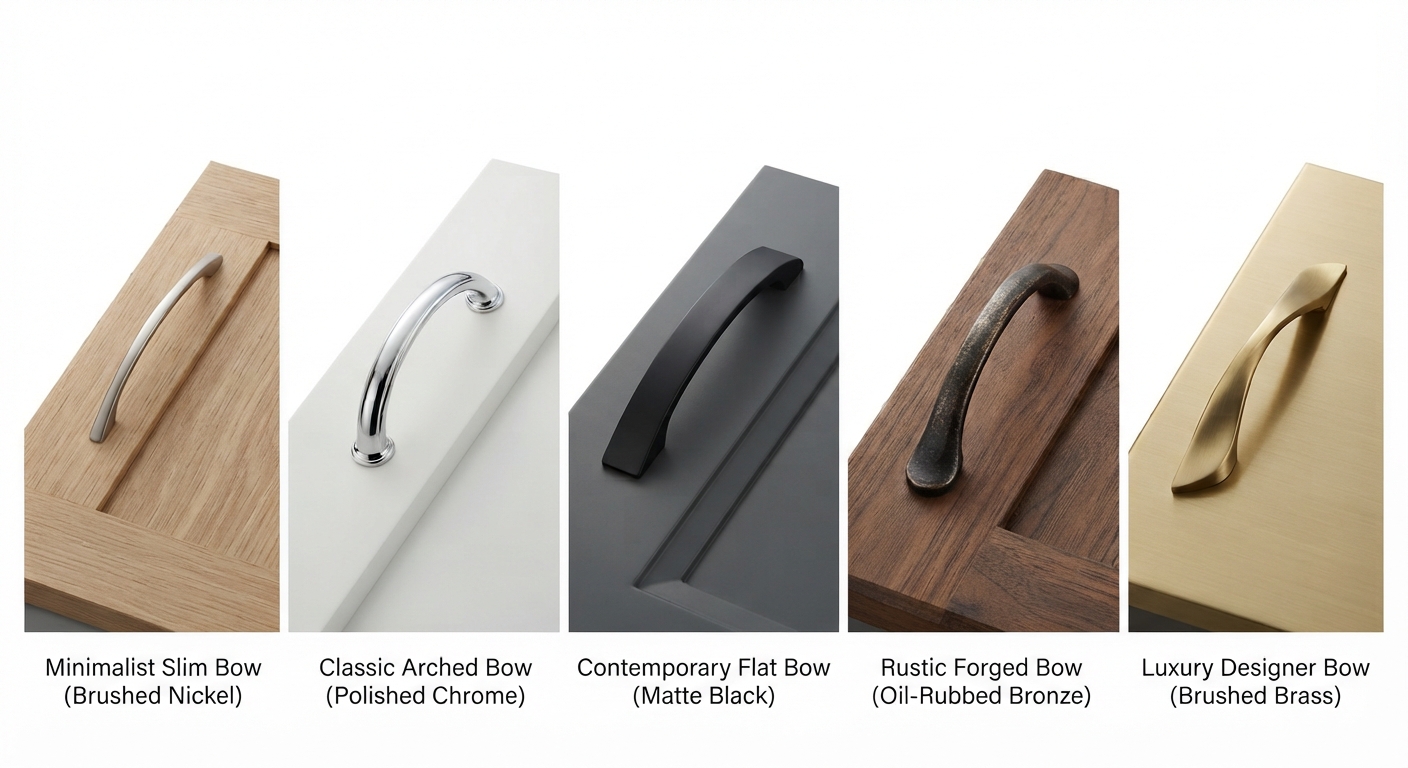
A bow pull has a curved gripping section that connects two mounting points.
The curve may be:
- Shallow
- Deep
- Rounded
- Angular
- Decorative
Bow pulls are available in modern, transitional and traditional designs.
Common Applications
- Kitchen cabinets
- Office furniture
- Wardrobes
- Bathroom vanities
- Bedroom furniture
- Traditional cabinets
Main Advantages
- Comfortable curved grip
- Smooth visual appearance
- Fewer projecting ends
- Suitable for many interior styles
- Available in decorative designs
Possible Limitations
- Curved designs may be harder to clean
- Grip clearance varies considerably
- Decorative styles may be difficult to replace
- Accurate center-to-center drilling is required
What Is an Edge Pull?

An edge pull is mounted along the edge of a cabinet door or drawer front.
It normally creates a thin visible lip that users grip from the front, top, bottom or side.
Edge pulls may also be called:
- Cabinet edge handles
- Lip pulls
- Tab pulls
- Edge-mounted handles
- Top-mounted pulls
Common Applications
- Minimalist kitchens
- Modern drawers
- Wardrobe doors
- Bathroom cabinets
- Handle-reduced furniture
- Apartment projects
Main Advantages
- Minimal visual interruption
- Lower apparent projection
- Clean cabinet fronts
- Suitable for modern design
- Available in short and long formats
Possible Limitations
- Grip may be smaller than a bar pull
- Door-thickness compatibility must be checked
- Incorrect sizing may affect cabinet gaps
- Thin edges can be uncomfortable if poorly finished
- Fixing screws may be visible from the back
- Replacement may require the same mounting pattern
What Is a Finger Pull?

“Finger pull” is a broad term describing hardware operated with one or more fingers.
A finger pull may be:
- A small surface-mounted tab
- An edge-mounted grip
- A recessed pull
- A shaped lip
- Part of an integrated profile
Because the term is broad, one supplier’s finger pull may be another supplier’s edge pull.
Common Applications
- Minimalist kitchen cabinets
- Small drawers
- Wardrobes
- Sliding doors
- Bathroom vanities
- Compact furniture
Main Advantages
- Compact appearance
- Reduced projection
- Suitable for small doors
- Minimalist styling
- Available in surface-mounted or recessed designs
Possible Limitations
- Smaller gripping area
- May be difficult on heavy doors
- Recessed versions require accurate machining
- Product terminology is inconsistent
- Comfort depends heavily on edge shape and depth
Bar Pull vs Bow Pull
Bar and bow pulls are both normally surface-mounted using two screws.
The main difference is shape.
Choose a Bar Pull When:
- Straight modern lines are required
- Long handle sizes are needed
- A larger grip is preferred
- The cabinet uses contemporary styling
- Different lengths must be coordinated
Choose a Bow Pull When:
- A curved grip feels more comfortable
- Rounded shapes are preferred
- Traditional or transitional styling is required
- Projecting bar ends should be avoided
Functional Difference
A bar pull may provide more length options, especially for tall doors and wide drawers.
A bow pull may provide softer edges and a more enclosed grip.
The exact comfort depends on projection and grip clearance.
Bar Pull vs Edge Pull
These handles create very different cabinet appearances.
Bar Pull
- Mounted through the cabinet front
- Clearly visible
- Larger gripping area
- Usually greater projection
- Easier to use on heavy doors
Edge Pull
- Mounted along the door or drawer edge
- Visually more discreet
- Lower apparent projection
- Requires door-thickness and gap checks
- Often selected for minimalist cabinetry
Choose based on both design and required opening force.
A small edge pull should not be assumed suitable for every heavy wardrobe or appliance door.
Bow Pull vs Finger Pull
Bow Pull
- Larger curved grip
- Usually two-hole surface mounting
- Suitable for frequent use
- More visible decorative element
Finger Pull
- Smaller or recessed grip
- Installation varies
- More minimalist appearance
- May require edge machining or special drilling
Bow pulls generally provide more space for the hand.
Finger pulls reduce visual impact but should be physically tested for comfort.
Edge Pull vs Finger Pull
These terms may overlap.
A useful distinction is:
- Edge pull: Mounted directly to the edge or rear face of the door and creates a visible lip
- Finger pull: Any compact handle designed for fingertip operation, including surface, edge-mounted and recessed products
Do not rely on the name alone.
Confirm:
- Installation position
- Cross-section
- Fixing method
- Door-thickness range
- Required cutout
- Projection
- Grip clearance
Grip Comparison
Bar Pull Grip
Usually allows several fingers or the complete hand to grip the handle.
Suitable for:
- Frequent use
- Wide drawers
- Tall doors
- Doors requiring more pulling force
Bow Pull Grip
Provides a curved grip that can feel comfortable and secure.
Check that the center section provides adequate clearance.
Edge-Pull Grip
Users normally grip underneath or behind a metal lip.
Comfort depends on:
- Lip depth
- Edge thickness
- Projection
- Installation position
Finger-Pull Grip
May use one or two fingers.
Suitable for lightweight doors but potentially less comfortable for heavy or frequently used cabinets.
Projection Comparison
Projection affects cabinet clearance and user comfort.
|
Pull Type |
Typical Projection Characteristic |
|
Bar pull |
Usually projects clearly from the cabinet |
|
Bow pull |
Moderate projection with a curved grip |
|
Edge pull |
Low visual projection but includes a gripping lip |
|
Finger pull |
Often compact or recessed |
Exact dimensions vary by model.
Check projection when the cabinet is located near:
- A wall
- Another cabinet
- A corner
- A walkway
- An appliance
- An adjacent handle
Drilling and Installation Comparison
Bar and Bow Pulls
Commonly require:
- Two mounting holes
- Accurate C-C spacing
- Screws installed from behind
- Suitable screw length
Edge Pulls
May require:
- Rear-face screw holes
- Edge mounting
- Pilot holes
- Specific door thickness
- A controlled gap between adjacent fronts
Finger Pulls
Installation may involve:
- One or more screws
- Edge fixing
- Surface mounting
- Routing or mortising
- Adhesive combined with mechanical fixing
The installation drawing should be approved before cabinet production.
Replacement Compatibility
Bar and Bow Pulls
Replacement is simpler when the new pull matches:
- Existing C-C spacing
- Base coverage
- Overall dimensions
- Screw specification
Edge Pulls
Replacement may require the same:
- Length
- Screw positions
- Edge profile
- Door-thickness compatibility
Previous fixing marks may remain visible when changing to a smaller pull.
Finger Pulls
Recessed finger pulls are often difficult to replace with a different model because the door has already been machined.
Approve long-term replacement requirements before production.
Material Options
Zinc Alloy
Frequently used for bar and bow pulls with decorative shapes and finishes.
Aluminum
Common for:
- Edge pulls
- Profile handles
- Long minimalist pulls
- Finger-pull profiles
It is lightweight and suitable for extrusion.
Stainless Steel
Used for modern bar pulls and frequently operated furniture.
Confirm whether the complete handle or only certain components are stainless steel.
Brass
Common in premium and decorative bar, bow and finger-pull designs.
Confirm whether the product is solid brass or brass finished.
Steel
Used for economical bar, bow and wire pulls.
Its corrosion performance depends on the protective coating.
Choosing Pulls for Kitchen Cabinets
Modern Kitchen
Consider:
- Bar pulls
- Edge pulls
- Finger pulls
Transitional Kitchen
Consider:
- Simple bow pulls
- Refined bar pulls
- Coordinated knobs and pulls
Traditional Kitchen
Consider:
- Decorative bow pulls
- Cup pulls
- Knobs
Heavy Drawers
Bar or bow pulls may provide a larger grip.
Check handle strength, fixing and drawer-slide operation.
Minimalist Kitchen
Edge or finger pulls may create a cleaner cabinet front.
Confirm comfort and cleaning requirements before approval.
Choosing Pulls for Wardrobes
Tall wardrobe doors often benefit from:
- Long bar pulls
- Long edge pulls
- Profile handles
- Substantial bow pulls
Consider:
- Door height and weight
- Handle length
- Pulling force
- User reach
- Screw quantity
- Panel construction
A compact finger pull may suit a lightweight door but feel inadequate on a tall, heavy wardrobe.
Choosing Pulls for Bathroom Vanities
Evaluate:
- Humidity
- Cleaning chemicals
- Wet-hand grip
- Surface finish
- Corrosion resistance
- Ease of cleaning
Edge and finger pulls can create a clean appearance, while bar and bow pulls may provide a more reliable grip when hands are wet.
Choosing Pulls for Hotels and Apartments
Project buyers should consider:
- Standardized sizes
- Batch finish consistency
- Installation speed
- Comfortable operation
- Easy cleaning
- Replacement availability
- Packaging identification
- Spare-parts inventory
A highly customized recessed finger pull may produce a distinctive design but may also increase machining and future replacement complexity.
Balance appearance with project maintenance requirements.
Choosing the Right Size
Bar and Bow Pulls
Confirm:
- Center-to-center spacing
- Overall length
- Projection
- Grip clearance
- Base dimensions
Edge Pulls
Confirm:
- Overall length
- Lip depth
- Projection
- Door thickness
- Screw positions
- Edge coverage
Finger Pulls
Confirm:
- Overall dimensions
- Grip depth
- Installation method
- Required recess
- Cutout dimensions
- Panel thickness
For every type, use the approved drawing rather than estimating dimensions from photographs.
Handle Selection by Priority
|
Main Priority |
Recommended Starting Point |
|
Maximum grip |
Bar or bow pull |
|
Minimalist appearance |
Edge or finger pull |
|
Tall wardrobe |
Long bar or edge pull |
|
Heavy drawer |
Strong bar or bow pull |
|
Traditional furniture |
Decorative bow pull |
|
Low projection |
Edge or recessed finger pull |
|
Simple replacement |
Standard C-C bar or bow pull |
|
Integrated appearance |
Profile or recessed finger pull |
The final choice should be confirmed through physical testing.
Cleaning and Maintenance
Bar Pulls
Simple straight bars are generally easy to wipe, although extended ends and bases may collect dirt.
Bow Pulls
Curved surfaces are comfortable but decorative details may require additional cleaning.
Edge Pulls
The rear gripping lip can collect dust or kitchen residue if it is difficult to access.
Finger Pulls
Recessed designs may collect debris inside the cavity.
For kitchen, hospitality and commercial applications, evaluate cleaning access as part of the sample review.
Project Specification Checklist
Before ordering, confirm:
- Pull type
- Cabinet application
- Door or drawer dimensions
- Door weight
- Base material
- Surface finish
- Center-to-center spacing
- Overall length
- Projection
- Grip clearance
- Door-thickness range
- Fixing method
- Screw specification
- Cutout dimensions where required
- Quantity
- Packaging
- Spare-parts requirement
- Physical sample
- Technical drawing
Common Selection Mistakes
Selecting Edge Pulls Without Checking Door Thickness
The fixing and visible lip may not fit correctly.
Choosing Finger Pulls for Heavy Doors Without Testing
The gripping area may be insufficient.
Confusing Edge Pulls and Finger Pulls
Supplier terminology may describe different structures.
Ignoring Extended Bar Ends
They may catch clothing in narrow spaces.
Comparing Only Overall Length
Mounting and grip dimensions may be completely different.
Drilling Before Sample Approval
A change in C-C spacing or fixing method can make completed doors unusable.
Ignoring Cleaning Access
Recesses and gripping lips may collect dirt.
Using Decorative Pulls on Appliances
Integrated appliance doors may require specially designed appliance pulls.
Selecting Only by Appearance
Grip, strength and installation must also be evaluated.
Frequently Asked Questions
What is the difference between a bar pull and a bow pull?
A bar pull has a straight gripping section, while a bow pull has a curved section between its mounting points.
What is an edge pull?
An edge pull is mounted along the edge or rear surface of a cabinet front and provides a lip for opening it.
What is a finger pull?
A finger pull is a compact grip operated with the fingertips. It may be surface mounted, edge mounted or recessed.
Are edge pulls and finger pulls the same?
Sometimes the terms overlap, but not always. Confirm the product’s mounting method and technical drawing.
Which pull provides the best grip?
Bar and bow pulls usually provide a larger gripping area. The actual comfort depends on clearance, projection and shape.
Which pull is best for minimalist kitchens?
Edge pulls, finger pulls and profile handles are common choices. They should still be tested for comfort and cleaning.
Can edge pulls be installed on any door thickness?
No. The product must be compatible with the panel thickness and cabinet gaps.
Are finger pulls suitable for heavy drawers?
Some may be, but compact finger pulls can provide limited leverage. Test the actual drawer and confirm the product’s fixing strength.
Which handle type is easiest to replace?
Standard bar and bow pulls may be easier to replace when their C-C spacing is documented and commonly available.
Should handles be approved before cabinet drilling?
Yes. Approve the physical sample, mounting method and technical drawing before production.
Conclusion
Bar pulls, bow pulls, edge pulls and finger pulls serve different design and functional requirements.
- Bar pulls provide straight lines and a large gripping area.
- Bow pulls provide a curved, comfortable grip.
- Edge pulls create a minimalist appearance with an edge-mounted lip.
- Finger pulls provide a compact or recessed gripping point.
The correct choice depends on:
- Cabinet style
- Door or drawer dimensions
- Required grip
- Projection
- Mounting method
- Panel thickness
- Cleaning
- Replacement requirements
For cabinet manufacturers and project buyers, the product name alone is not sufficient. Always review the technical drawing and install a representative sample before drilling or mass production.
Related Haits Product Categories
Zinc Alloy vs Aluminum vs Stainless Steel vs Brass Cabinet Handles
Cabinet Handle Sizes Explained


