
What Are Cabinet Handles and Pulls?

What Are Cabinet Handles and Pulls?
Cabinet handles and pulls are hardware components used to open cabinet doors, drawers, wardrobes and other furniture.
They provide a gripping point that allows users to operate the cabinet without touching the door or drawer surface directly.
However, handles are not only functional components. They also influence:
- Cabinet appearance
- User comfort
- Opening convenience
- Furniture style
- Cleaning and maintenance
- Perceived product quality
For cabinet manufacturers, interior designers, joinery contractors and project buyers, selecting the correct handle requires consideration of type, size, material, finish, installation and application.
Quick Answer: What Is a Cabinet Handle?
A cabinet handle is a piece of furniture hardware attached to a cabinet door or drawer front to provide a gripping point.
Common cabinet-hardware types include:
- Pull handles
- Bar pulls
- Bow pulls
- Cabinet knobs
- Cup pulls
- Edge pulls
- Finger pulls
- Recessed pulls
- Profile handles
- Appliance pulls
The best choice depends on the cabinet design, door dimensions, required grip, mounting method and interior style.
Cabinet Handle vs Cabinet Pull: Is There a Difference?
The terms cabinet handle and cabinet pull are often used interchangeably.
In many international markets, “cabinet handle” is the broader term.
In the United States, “cabinet pull” and “drawer pull” are commonly used for handles attached with two or more screws.
A simple distinction is:
- Handle: General term for hardware used to grip and open a door or drawer
- Pull: A handle designed to be pulled, commonly attached at two mounting points
- Knob: A compact grip normally attached with one screw
For international product pages, using both “cabinet handles” and “cabinet pulls” helps customers and search engines understand the product category.
1. Pull Handles
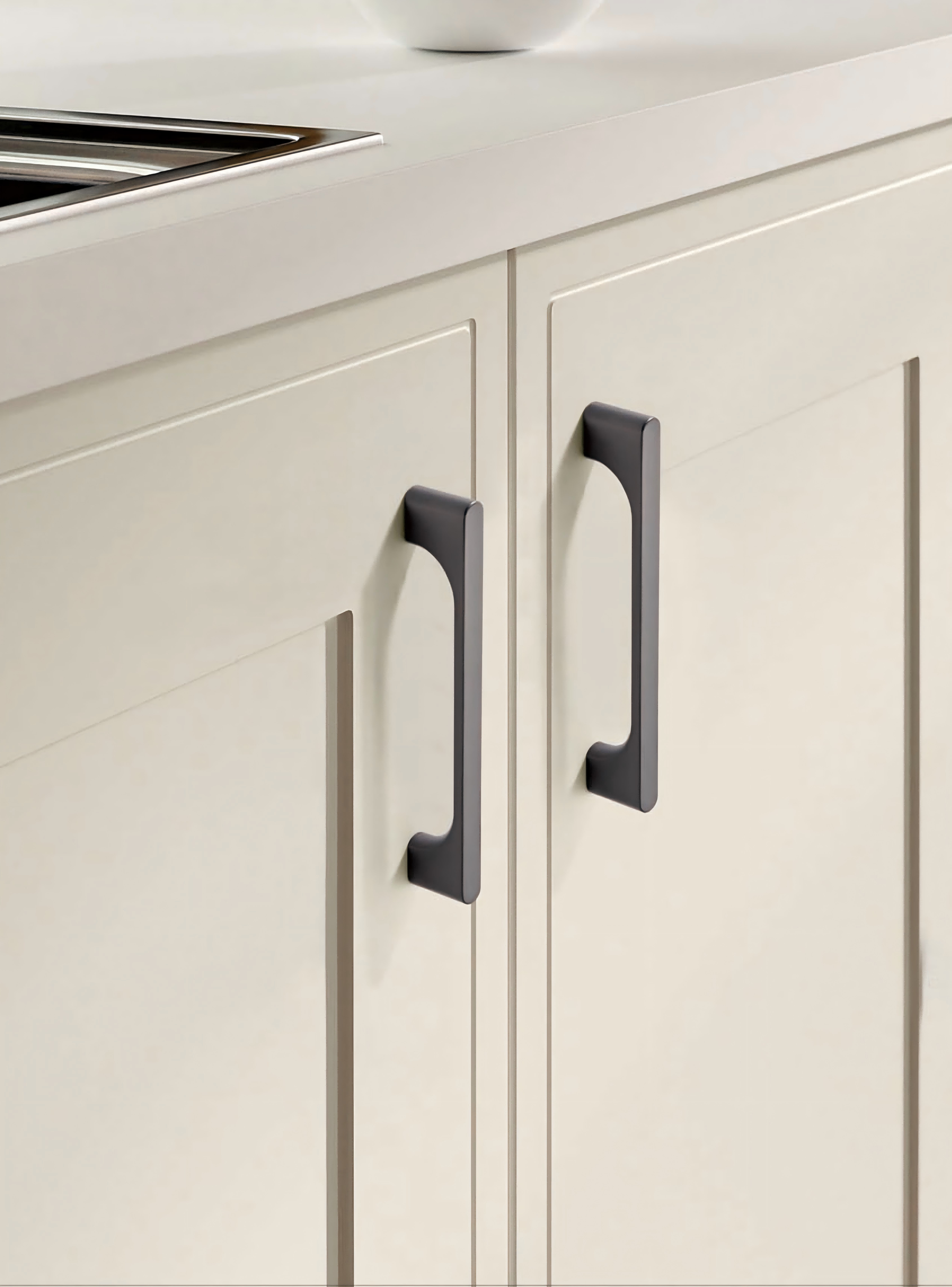
A pull handle is attached to a door or drawer using two or more fixing points.
It creates a space between the handle and cabinet surface for the user’s fingers.
Common Applications
- Kitchen cabinets
- Wardrobes
- Bathroom vanities
- Office furniture
- Hotel furniture
- Drawer systems
Advantages
- Comfortable grip
- Wide range of sizes
- Suitable for doors and drawers
- Available in many materials and finishes
- Easy to coordinate across a complete furniture collection
Pull handles are one of the most common choices for residential and commercial cabinets.
2. Bar Pulls

Bar pulls have a straight, simple shape and are widely used in modern cabinet design.
They may have:
- Round bars
- Square bars
- Rectangular profiles
- T-shaped ends
- Straight or extended ends
Typical Applications
- Modern kitchens
- Apartment cabinets
- Office furniture
- Contemporary wardrobes
- Bathroom vanities
Advantages
- Clean appearance
- Comfortable gripping area
- Suitable for different cabinet sizes
- Easy to match with modern interiors
Long bar pulls are often used on wide drawers and tall cabinet doors.
The handle size should remain proportional to the door or drawer front.
3. Bow Pulls

Bow pulls have a curved gripping section between the two mounting points.
They are available in modern, transitional and traditional designs.
Advantages
- Comfortable grip
- Smooth shape
- Reduced sharp corners
- Suitable for many furniture styles
Common Applications
- Kitchen cabinets
- Bedroom furniture
- Wardrobes
- Office cabinets
- Traditional furniture
Bow pulls can provide a softer visual appearance than straight bar pulls.
4. Cabinet Knobs

A cabinet knob is normally attached using one screw.
Common knob shapes include:
- Round
- Square
- Oval
- Rectangular
- T-shaped
- Decorative or sculpted
Advantages
- Simple installation
- Compact size
- Suitable for small doors
- Wide range of decorative styles
- Usually requires only one drilling hole
Common Applications
- Small cabinet doors
- Kitchen wall cabinets
- Bathroom vanities
- Bedside furniture
- Traditional furniture
Knobs require less drilling than pull handles, but they usually provide a smaller gripping area.
5. Cup Pulls

Cup pulls, also called bin pulls, have a curved or covered grip that users pull from underneath.
They are strongly associated with:
- Traditional kitchens
- Shaker cabinets
- Farmhouse furniture
- Vintage-style drawers
Advantages
- Distinctive decorative appearance
- Comfortable drawer grip
- Suitable for traditional and transitional furniture
Cup pulls are more commonly installed on drawers than on vertical cabinet doors.
Their shape and fixing pattern should be confirmed before drilling.
6. Edge Pulls
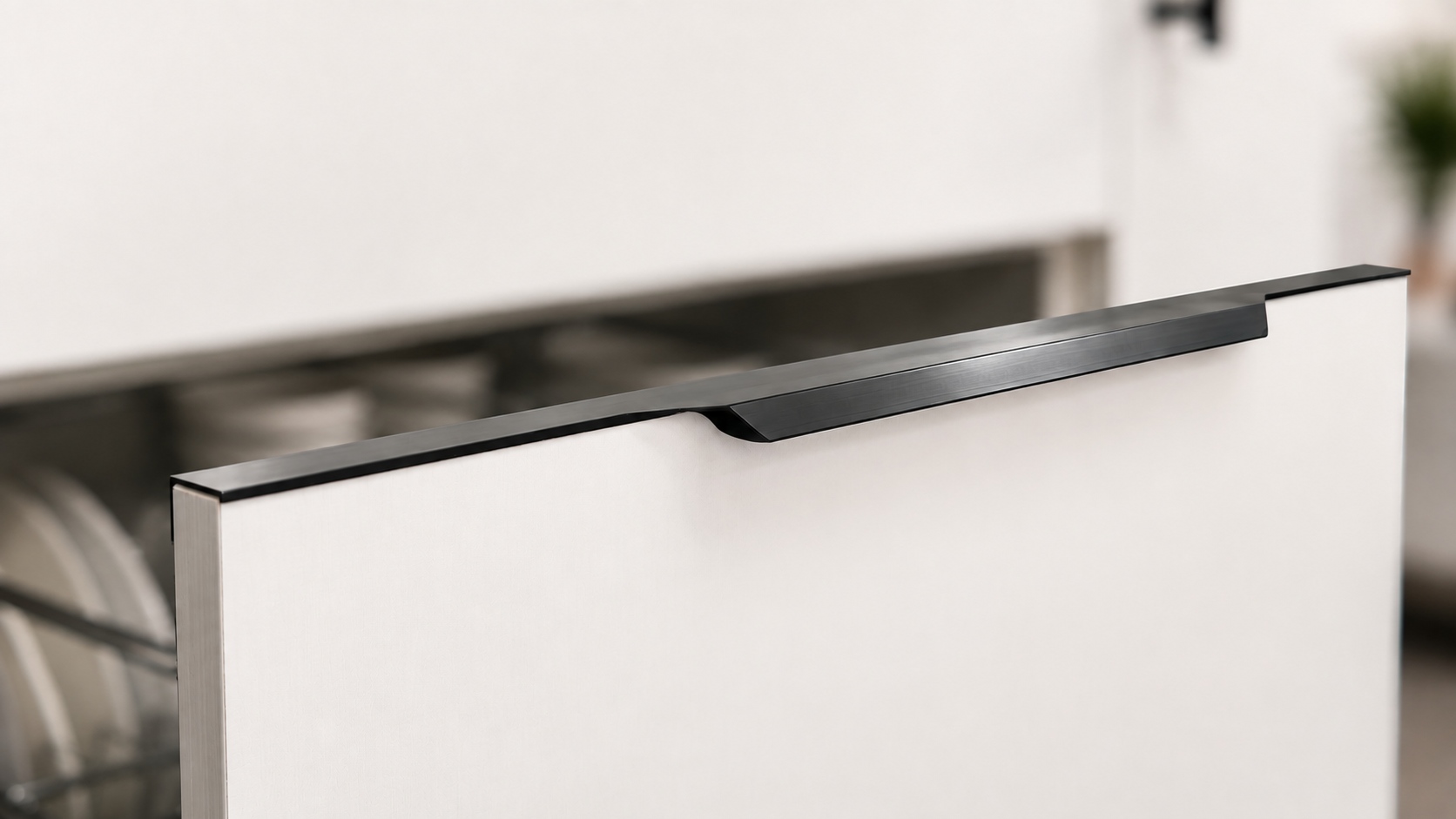
Edge pulls are fitted to the top, bottom or side edge of a cabinet door or drawer.
The visible part may be a thin metal lip rather than a conventional projecting handle.
They are also called:
- Tab pulls
- Lip pulls
- Cabinet edge handles
- Edge-mounted pulls
Advantages
- Minimalist appearance
- Reduced visual interruption
- Suitable for modern cabinetry
- Available in short or full-length designs
Installation Considerations
Check:
- Door thickness
- Edge clearance
- Screw position
- Projection
- Adjacent door gaps
- Opening comfort
Incorrect sizing may cause interference between adjacent doors or drawers.
7. Finger Pulls
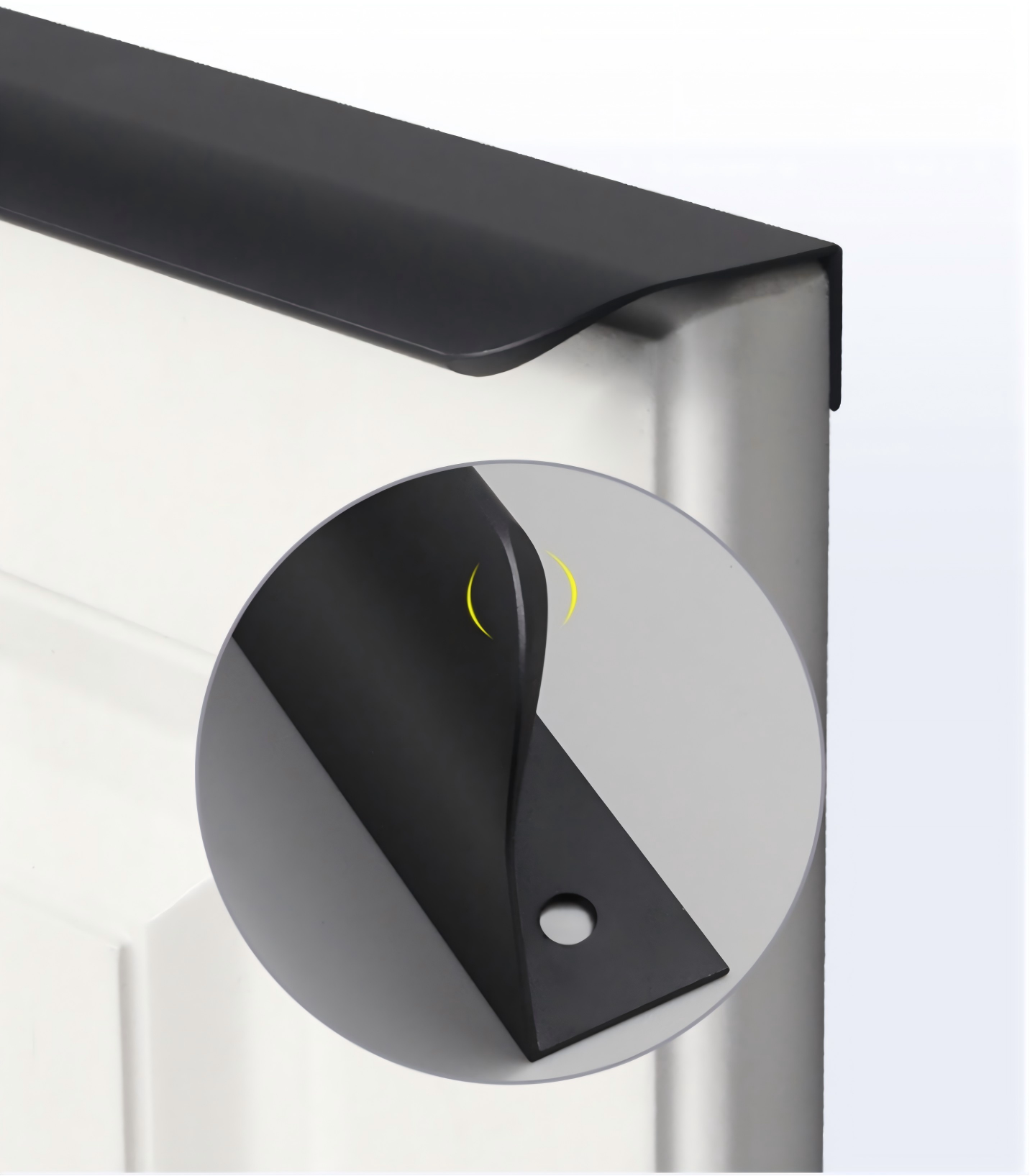
Finger pulls allow users to open a cabinet using a small grip, lip or shaped recess.
Depending on the design, a finger pull may be:
- Surface mounted
- Edge mounted
- Integrated into a profile
- Recessed into the door
Common Applications
- Minimalist kitchens
- Modern wardrobes
- Bathroom cabinets
- Compact furniture
- Handle-reduced designs
Finger pulls provide a cleaner visual appearance but should be tested for comfort, especially on heavy or frequently used doors.
8. Recessed and Mortise Pulls

A recessed pull sits partly or completely inside the door or drawer surface.
It normally requires machining or routing rather than simple surface mounting.
Advantages
- Low projection
- Reduced risk of snagging
- Suitable for sliding doors
- Useful in narrow spaces
- Clean, integrated appearance
Common Applications
- Sliding wardrobe doors
- Pocket doors
- Office furniture
- Marine or transport furniture
- Space-saving cabinets
The recess dimensions must match the handle accurately.
These handles should be approved before machining the door.
9. Profile Handles

Profile handles are normally made from an extruded metal profile and installed along a cabinet edge.
Common forms include:
- J-profile handles
- C-profile handles
- L-shaped handles
- Full-length edge profiles
They are frequently made from aluminum because it is lightweight and suitable for extrusion.
Advantages
- Clean, continuous lines
- Suitable for long doors and drawers
- Modern appearance
- Available in matching cabinet systems
Important Distinction
A profile attached directly to the cabinet door is a handle.
A rail installed between cabinet panels to create a grip channel may form part of a handleless cabinet system.
The two systems require different cabinet construction and installation planning.
10. Appliance Pulls
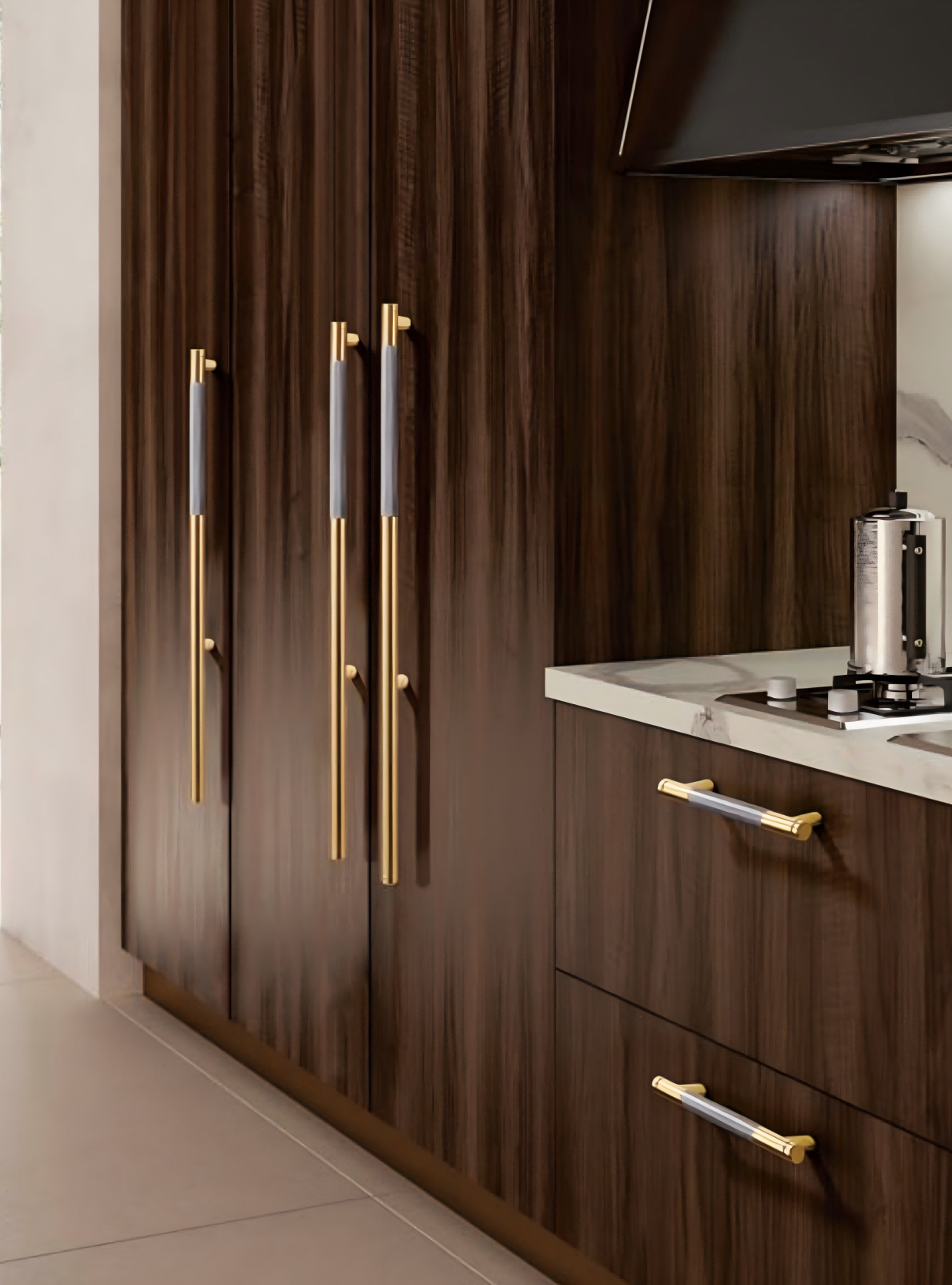
Appliance pulls are longer and heavier than standard cabinet pulls.
They are designed for:
- Integrated refrigerators
- Freezers
- Dishwashers
- Large pantry doors
- Heavy cabinet fronts
Important Considerations
Appliance pulls should be evaluated for:
- Door weight
- Pulling force
- Fixing strength
- Screw size
- Panel construction
- Overall length
- Projection
A standard decorative cabinet handle should not automatically be used as an appliance pull.
Cabinet Handle Type Comparison
|
Handle Type |
Mounting |
Style |
Typical Application |
|
Bar pull |
Usually two screws |
Modern |
Kitchens and wardrobes |
|
Bow pull |
Usually two screws |
Universal |
Cabinets and furniture |
|
Knob |
Usually one screw |
Classic or modern |
Small doors |
|
Cup pull |
Multiple or concealed fixings |
Traditional |
Drawers |
|
Edge pull |
Edge or rear mounting |
Minimalist |
Modern kitchens |
|
Finger pull |
Surface, edge or recessed |
Minimalist |
Doors and drawers |
|
Recessed pull |
Machined into panel |
Integrated |
Sliding doors |
|
Profile handle |
Edge or full-length mounting |
Contemporary |
Kitchens and wardrobes |
|
Appliance pull |
Heavy fixing |
Substantial |
Integrated appliances |
Cabinet Handle Measurements Explained

Selecting the correct handle requires understanding several dimensions.
Center-to-Center Measurement
Center-to-center, often abbreviated as C-C, is the distance between the centers of two mounting holes.
For example:
A handle described as 160mm C-C has 160mm between its two fixing holes.
This is one of the most important dimensions when replacing or specifying cabinet pulls.
Overall Length
Overall length is the complete length from one end of the handle to the other.
It is normally longer than the center-to-center measurement.
Projection
Projection is the distance the handle extends from the cabinet surface.
Projection affects:
- Grip comfort
- Cabinet clearance
- Adjacent door movement
- Risk of catching clothing
- Visual appearance
Grip Clearance
Grip clearance is the usable space between the handle and cabinet surface.
A handle may look large but still provide limited finger space.
Width or Diameter
This describes the thickness or cross-section of the grip.
Base Dimensions
The base is the part of the handle that contacts the cabinet surface.
Base dimensions may be important when covering existing holes or surface marks.
Common Center-to-Center Sizes
Cabinet pulls are available in many sizes, including common metric dimensions such as:
- 64mm
- 96mm
- 128mm
- 160mm
- 192mm
- 224mm
- 256mm
- 320mm
Imperial markets may also use hole spacing measured in inches.
These are common product sizes, not mandatory rules. Buyers should confirm the exact drawing before drilling.
When replacing handles, measure the existing holes rather than estimating from the overall handle length.
Cabinet Handle Materials
Zinc Alloy
Zinc alloy is widely used for decorative cabinet handles.
Advantages
- Suitable for detailed shapes
- Wide range of finishes
- Good design flexibility
- Cost-effective for mass production
- Suitable for knobs and decorative pulls
Considerations
Quality depends on alloy composition, casting, polishing and surface treatment.
Aluminum
Aluminum is commonly used for:
- Profile handles
- Edge pulls
- Long handles
- Minimalist designs
Advantages
- Lightweight
- Suitable for extrusion
- Available in long lengths
- Modern appearance
- Good design flexibility
Considerations
Thin profiles may feel less substantial or deform if incorrectly designed for the application.
Stainless Steel
Stainless steel is used for handles requiring a clean, durable appearance.
Advantages
- Strong
- Modern appearance
- Suitable for frequent use
- Available in brushed and polished finishes
Considerations
The grade, construction and surface treatment should be confirmed. Some handles described as stainless steel may use stainless-steel tubes with different base materials or fittings.
Brass
Brass is commonly associated with premium or traditional hardware.
Advantages
- Premium appearance
- Substantial feel
- Suitable for decorative finishes
- Available in polished, brushed and aged styles
Considerations
Solid brass and brass-finished products are different. Buyers should confirm the base material.
Some unlacquered brass surfaces naturally change appearance over time.
Steel
Steel handles can provide strength and cost efficiency.
Their corrosion resistance depends heavily on the protective finish.
They are commonly used in:
- Wire pulls
- Utility furniture
- Economical cabinet hardware
- Industrial-style products
Cabinet Handle Finishes

Common finishes include:
- Matt black
- Brushed nickel
- Satin nickel
- Polished chrome
- Brushed chrome
- Satin brass
- Polished brass
- Antique brass
- Bronze
- Gunmetal
- Stainless-steel effect
- White
- Custom colors
Finish names are not always identical between suppliers.
For project orders, approve a physical color sample rather than relying only on photographs or finish names.
How to Choose a Cabinet Handle
1. Confirm the Application
Is the handle for:
- A small cabinet door?
- A wide drawer?
- A tall wardrobe?
- An integrated appliance?
- A bathroom vanity?
- A hotel project?
2. Check Door or Drawer Size
Large doors usually require a handle with sufficient gripping area and suitable visual proportion.
3. Consider the Opening Force
Heavy doors and appliance fronts may require stronger handles and fixings.
4. Select the Mounting Method
Confirm:
- Number of screws
- Center-to-center distance
- Screw diameter
- Screw length
- Panel thickness
- Front or rear fixing
5. Evaluate Grip Comfort
The handle should provide enough clearance for the intended users and application.
6. Match the Cabinet Style
Consider:
- Modern
- Minimalist
- Traditional
- Transitional
- Industrial
- Luxury
7. Check the Environment
Bathroom, coastal and commercial applications may require improved corrosion and cleaning resistance.
8. Test a Physical Sample
Check the handle on the actual cabinet door before mass production.
Cabinet Handles for Different Applications
Kitchen Cabinets
Common choices include:
- Bar pulls
- Bow pulls
- Knobs
- Cup pulls
- Edge pulls
- Profile handles
Kitchen handles should be comfortable, easy to clean and suitable for frequent use.
Wardrobes
Wardrobes may use:
- Long bar pulls
- Profile handles
- Recessed pulls
- Edge pulls
- Decorative handles
Tall or heavy doors require secure fixings and sufficient grip.
Bathroom Vanities
Consider:
- Moisture exposure
- Cleaning chemicals
- Corrosion resistance
- Easy-to-clean shapes
- Comfortable operation
Office Furniture
Common priorities include:
- Durability
- Simple appearance
- Easy replacement
- Standard hole spacing
- Consistent supply
Hotel and Apartment Projects
Project buyers should consider:
- Product standardization
- Batch color consistency
- Packaging identification
- Installation efficiency
- Spare-parts availability
- Long-term replacement compatibility
Handle Placement
Handle position affects comfort and appearance.
Common locations include:
- Near the opening edge of cabinet doors
- Centered on small drawers
- Horizontally positioned on wide drawers
- Vertically positioned on tall doors
- Mounted along the top edge of drawer fronts
- Mounted along the side edge of wardrobe doors
Before drilling, check:
- Door-opening direction
- Adjacent handles
- Door gaps
- Drawer movement
- Internal hardware
- User reach
- Visual alignment
Consistent placement is particularly important across large kitchen and wardrobe projects.
Handle Installation Requirements
Most surface-mounted handles require screws passing through the back of the cabinet door or drawer front.
Confirm:
- Panel thickness
- Screw length
- Screw diameter
- Hole spacing
- Washer requirements
- Thread depth
- Installation torque
A screw that is too short may not engage securely.
A screw that is too long may prevent tightening or damage the handle.
For doors with varying thicknesses, more than one screw length may be required.
Common Cabinet Handle Selection Mistakes
Choosing by Appearance Only
A visually attractive handle may provide poor grip or insufficient strength.
Confusing Overall Length With Center-to-Center
This can result in incorrect drilling.
Ignoring Door Thickness
The supplied screws may not suit every cabinet panel.
Using Small Handles on Heavy Doors
The handle may be uncomfortable or inadequately fixed.
Approving Color From a Screen
Digital images cannot reliably represent exact metal finishes.
Ignoring Projection
A projecting handle may interfere with adjacent cabinets or catch clothing.
Replacing Handles Without Measuring Existing Holes
New handles may not cover or align with the existing drilling.
Using Standard Pulls on Appliances
Appliance doors may require stronger handles and fixing systems.
Skipping Sample Installation
The handle may look and feel different after installation on the actual cabinet.
Cabinet Handle Buyer Checklist
Before ordering, confirm:
- Handle type
- Application
- Base material
- Surface finish
- Center-to-center distance
- Overall length
- Projection
- Grip clearance
- Base dimensions
- Screw size
- Screw length
- Door thickness
- Door weight
- Required quantity
- Packaging
- Color sample
- Testing requirement
- Spare-parts requirement
- OEM branding
Frequently Asked Questions
What is the difference between a cabinet handle and a cabinet pull?
“Cabinet handle” is a broad term. “Cabinet pull” commonly describes a handle that is pulled and attached using two or more mounting points.
What is the difference between a knob and a pull?
A knob usually uses one screw and provides a compact grip. A pull commonly uses two screws and provides a larger gripping area.
What does center-to-center mean?
Center-to-center is the distance between the centers of the mounting holes on a cabinet pull.
Is overall length the same as center-to-center?
No. Overall length measures the complete handle, while center-to-center measures only the distance between mounting holes.
Which cabinet-handle material is best?
There is no universal best material. The choice depends on design, price, strength, environment and required finish.
Are aluminum handles suitable for wardrobes?
Yes. Aluminum is commonly used for long profile and edge handles, but the profile strength and fixing method must suit the door.
Are knobs or pulls better for kitchen cabinets?
Both can work. Pulls generally provide a larger grip, while knobs require simpler drilling and can suit traditional or compact cabinets.
Can I use cabinet pulls on drawers?
Yes. They are frequently called drawer pulls when installed on drawer fronts.
How do I replace existing cabinet handles?
Measure the existing center-to-center hole spacing and select a compatible handle. Also check overall size, base dimensions and screw length.
Should all cabinet handles in a project have the same size?
Not necessarily. Large drawers and tall doors may require longer handles, but the design family and finish should remain coordinated.
Conclusion
Cabinet handles and pulls combine function, comfort and design.
The main product types include:
- Pull handles
- Bar pulls
- Bow pulls
- Knobs
- Cup pulls
- Edge pulls
- Finger pulls
- Recessed pulls
- Profile handles
- Appliance pulls
The correct selection depends on:
- Cabinet application
- Door or drawer dimensions
- Handle size
- Material
- Finish
- Grip comfort
- Mounting method
- Installation environment
For cabinet manufacturers and project contractors, technical dimensions such as center-to-center spacing, overall length, projection and screw specification are as important as appearance.
A representative sample should be installed and approved before drilling or mass production.
Related Haits Product Categories
How to Choose Cabinet Handles


