
How to Choose Furniture Connectors for Particleboard, MDF, Plywood and Solid Wood

How to Choose Furniture Connectors for Particleboard, MDF, Plywood and Solid Wood
Furniture connector performance depends on the material surrounding it.
A connector may rely on:
- Threads gripping the panel
- A cam housing being held inside a drilled hole
- A dowel fitting tightly in the substrate
- An insert expanding inside the material
- Adhesive bonding to the hole surface
- The remaining panel material resisting pull-out or splitting
Particleboard, MDF, plywood and solid wood provide different conditions for these functions.
The correct connector must therefore be selected together with the panel—not as an independent hardware item.
Quick Answer
For particleboard, use connectors and threads designed for wood-based panels, control drilling carefully and avoid excessive installation torque.
For MDF, use accurate pilot holes and avoid placing oversized fasteners too close to the edge because edge splitting can occur.
For plywood, consider veneer direction, internal voids and possible edge delamination. Test the connector in the actual plywood grade.
For solid wood, account for grain direction and moisture-related movement. Wide solid-wood panels may need connection details that permit seasonal expansion and contraction.
Cam locks, screws, dowels and inserts can be used with several materials, but the dimensions and performance must be validated separately for each substrate.
1. Why Does Panel Material Affect Connector Performance?

Furniture panels do not have one universal “wood strength.”
Their performance depends on:
- Density
- Internal structure
- Resin or adhesive system
- Surface layers
- Core quality
- Grain or veneer direction
- Moisture condition
- Panel thickness
- Distance from the edge
- Hole quality
- Fastener geometry
- Installation torque
2. Particleboard

Particleboard is produced from wood particles bonded into a panel.
It is widely used for:
- Kitchen cabinets
- Wardrobes
- Office furniture
- Shelving
- Flat-pack furniture
- Storage systems
Its relatively consistent panel format makes it suitable for high-volume drilling and furniture production.
However, particleboard does not behave like solid wood. Connector performance is influenced by particle size, density profile, core structure and panel quality.
Common Connectors for Particleboard
Possible systems include:
- Cam locks and connecting bolts
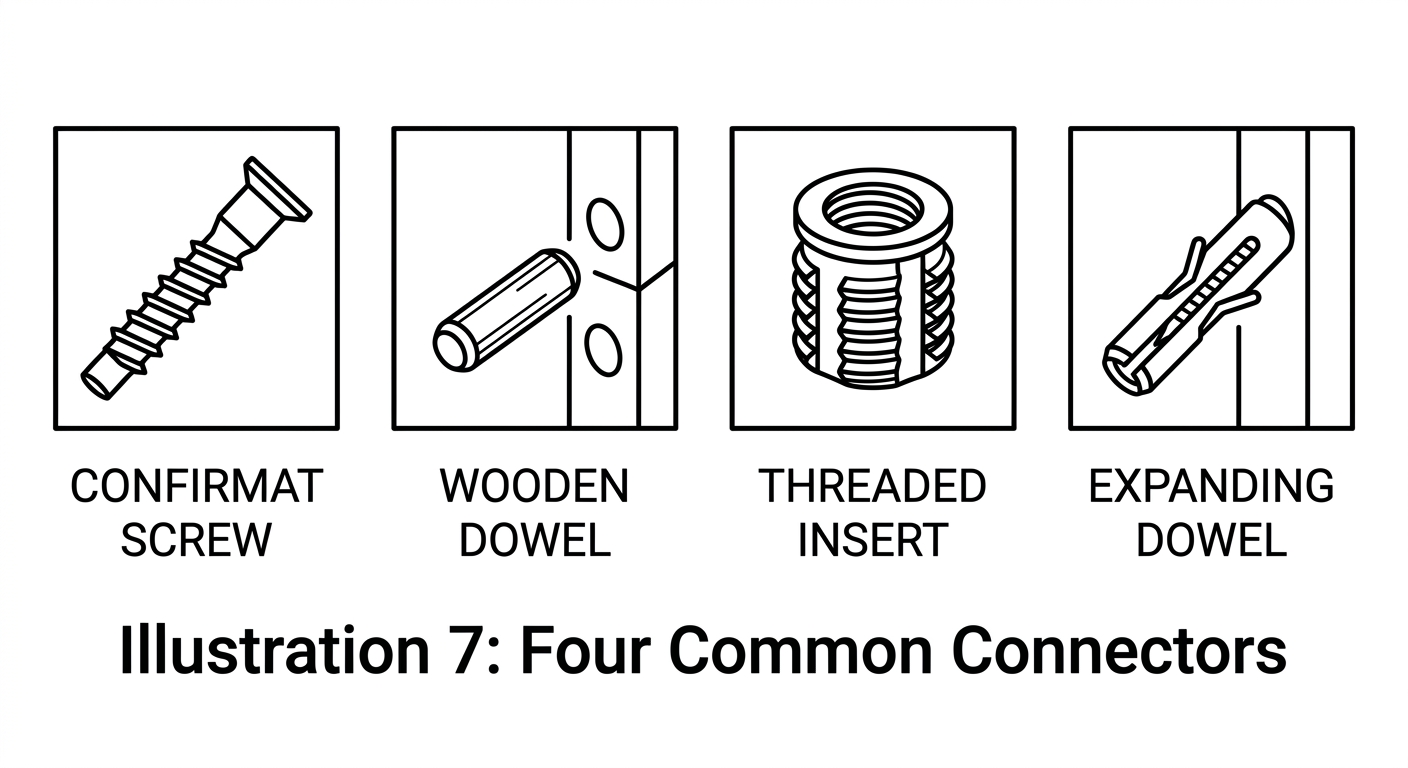
- Confirmat-style screws
- Wooden or plastic dowels
- Expanding dowels
- Threaded inserts designed for panel material
- Corner blocks
- Special cabinet connectors
Particleboard Advantages
- Suitable for repeatable CNC drilling
- Commonly used with cam-and-dowel systems
- Available in standard furniture-panel thicknesses
- Consistent flat surfaces
- Efficient for cabinet production
Particleboard Risks
- Screw threads can strip if over-tightened
- Edges may chip during drilling
- Large holes can weaken a narrow panel edge
- Repeated assembly may damage the original hole
- Low-density core material may reduce holding
- Moisture-damaged particleboard may lose connector performance
Recommended Approach
For particleboard furniture:
- Use a connector designed for panel furniture
- Confirm panel density and quality
- Use the specified pilot-hole diameter
- Control drilling depth
- Control installation torque
- Keep holes sufficiently separated
- Inspect the panel edge for chipping
- Test repeated assembly if required
- Do not reuse damaged holes without an approved repair method
3. MDF

MDF is produced from wood fibres bonded and pressed into a relatively uniform panel.
It is widely used for:
- Painted cabinet doors
- Furniture panels
- Decorative fronts
- Routed components
- Interior joinery
- Shelving
MDF generally machines with a smooth edge and can support precise routing. However, face and edge fastening performance can differ, and poor fastener selection may cause splitting or local crushing.
Common Connectors for MDF
Possible options include:
- Cam-lock systems
- Confirmat-style screws
- Wooden dowels with adhesive
- Threaded inserts
- Connector bolts
- Concealed routed connectors
- Surface-mounted brackets
MDF Advantages
- Uniform machining
- Clean routed pockets
- Suitable for CNC production
- Good painted surface
- Predictable face drilling when the panel is supported correctly
MDF Risks
- Edge splitting
- Surface breakout from deep holes
- Local crushing under excessive pressure
- Screw-hole stripping
- Fine dust remaining inside blind holes
- Reduced performance after repeated screw removal
Recommended Approach
For MDF:
- Use sharp tooling
- Support the workpiece during drilling
- Use the specified pilot hole
- Keep large holes away from thin edges
- Remove dust from blind holes
- Limit installation torque
- Test screw and insert performance in the edge direction
- Use inserts where repeated disassembly requires a durable thread
- Inspect painted or high-gloss faces for breakthrough and bulging
4. Plywood

Plywood is manufactured from multiple veneer layers bonded with their grain directions arranged across one another.
This cross-layered construction can provide useful dimensional stability and panel strength, but plywood quality varies significantly.
Important variables include:
- Wood species
- Number of plies
- Veneer thickness
- Core gaps
- Face grade
- Adhesive system
- Panel thickness
- Density
- Edge quality
Common Connectors for Plywood
Possible options include:
- Screws
- Connector bolts
- Threaded inserts
- Cam locks
- Wooden dowels
- Cross dowels
- Concealed connectors
- Brackets
Plywood Advantages
- Layered construction
- Good general machining with suitable tooling
- Strong visual edge in some furniture designs
- Suitable for screws and inserts when correctly specified
- Useful for cabinet, table and modular furniture
Plywood Risks
- Internal voids can affect connector position
- Veneer layers may split
- Edge drilling may create tear-out
- Thin outer veneers can be damaged by excessive torque
- Low-quality cores may provide inconsistent holding
- Large holes close to the edge may promote delamination
- Decorative exposed plywood edges make drilling defects visible
Recommended Approach
For plywood:
- Confirm the actual plywood grade and core construction
- Inspect cut edges for voids
- Use sharp drills and suitable backing
- Drill pilot holes for screws and inserts
- Avoid uncontrolled expansion near panel edges
- Position connectors away from known core gaps
- Test edge-installed connectors separately from face-installed connectors
- Check whether the exposed plywood edge forms part of the design
Do not assume all plywood of the same thickness has the same connector performance.
5. Solid Wood

Solid wood has a natural grain structure and changes dimension as its moisture condition changes.
Its properties vary according to:
- Species
- Density
- Grain direction
- Moisture content
- Growth pattern
- Defects
- Cut orientation
- Component size
A screw driven across the grain does not behave identically to one installed into end grain.
Common Connectors for Solid Wood
Possible options include:
- Wooden dowels
- Screws
- Threaded inserts
- Connector bolts
- Cross dowels
- Bed connectors
- Table connectors
- Concealed mechanical connectors
- Traditional joinery combined with hardware
Solid-Wood Advantages
- Strong material available for many mechanical connections
- Suitable for threaded inserts and bolts
- Compatible with traditional glued joinery
- Can be repaired or reworked in some applications
- Appropriate for tables, beds, chairs and premium furniture
Solid-Wood Risks
- Splitting along the grain
- Movement caused by changing moisture conditions
- End-grain connections behaving differently
- Warping or distortion
- Natural defects affecting drilling
- Rigid connectors restricting movement
- Visible damage on finished surfaces
Recommended Approach
For solid wood:
- Identify the species and grain direction
- Check moisture condition before production
- Use suitable pilot holes
- Keep fasteners away from ends and edges
- Avoid forcing expanding connectors into narrow components
- Consider seasonal movement in wide panels
- Use elongated holes or movement-compatible details where necessary
- Test connections in representative material
A connector should not rigidly restrain a wide solid-wood panel across the grain unless the joint has been designed for that movement.
Panel Comparison
|
Material |
Internal structure |
Main connector concern |
Typical production advantage |
|
Particleboard |
Bonded wood particles |
Thread stripping and weak damaged edges |
Efficient standardised cabinet production |
|
MDF |
Bonded wood fibres |
Edge splitting and local crushing |
Smooth, consistent machining |
|
Plywood |
Cross-laminated veneers |
Core gaps, tear-out and delamination |
Layered strength and distinctive edge |
|
Solid wood |
Natural grain |
Splitting and moisture movement |
Strong components and premium construction |
6. Choosing Cam Locks by Material
Cam Locks in Particleboard
Cam locks are widely used in particleboard cabinets and flat-pack furniture.
Check:
- Cam-hole fit
- Remaining material below the cam
- Bolt thread or sleeve
- Panel density
- Bolt projection
- Dowel alignment
- Repeated assembly requirement
Cam Locks in MDF
MDF can produce accurate cam holes, but excessive insertion pressure or poor edge drilling may cause splitting.
Check the bolt fixing carefully when it enters the MDF edge.
Cam Locks in Plywood
Cam systems may be used in plywood, but veneer layers, exposed edges and internal voids can affect drilling and appearance.
Produce a trial using the actual plywood grade.
Cam Locks in Solid Wood
Cam locks can be used for selected solid-wood or solid-wood-component applications, but grain direction and wood movement must be considered.
They should not automatically replace joinery designed specifically for solid wood.
7. Choosing Screws by Material
Particleboard
Use screws designed for wood-based panels and control installation torque carefully.
MDF
Use an appropriate pilot hole and prevent edge splitting. Threaded inserts may be considered when repeat assembly is required.
Plywood
Select screw length and pilot hole according to the plywood construction. Avoid placing the screw through a weak core gap.
Solid Wood
Select pilot holes according to species, screw and grain direction. Dense hardwoods and narrow components require particular care.
8. Choosing Dowels by Material
Particleboard
Dowels can provide alignment and may be glued, but hole fit and panel condition must be controlled.
MDF
MDF allows precise dowel drilling, but excessive interference may split the edge.
Plywood
Dowels can cross multiple veneers. Check the edge for tear-out and internal gaps.
Solid Wood
Wooden dowels are widely used, but grain direction, dowel moisture and adhesive compatibility affect the joint.
A dowel that is too tight can prevent the joint from closing or damage the component.
9. When Should a Threaded Insert Be Used?
A threaded insert may be useful when:
- Furniture will be assembled repeatedly
- A machine thread is required
- A removable bolt connection is preferred
- The panel material cannot tolerate repeated direct screw installation
- Controlled replacement is needed
The insert still depends on the surrounding material.
An insert that performs well in plywood or solid wood may not provide the same result in low-density particleboard.
Possible insert styles include:
- Screw-in insert
- Press-in insert
- Expanding insert
- Knock-in insert
- Bonded insert
Test installation torque, pull-out and panel damage before production.
10. Face Fixing vs Edge Fixing
The same panel may provide different performance when a connector is installed:
- Into its face
- Into its edge
- Near a corner
- Near another large drilled hole
Edge fixing often leaves less surrounding material and can increase splitting or pull-out risk.
USDA research treats face and edge screw holding as different properties for particleboard and MDF. Therefore, a face-mounted test cannot automatically approve an edge-installed connector.
Test the connector in the same orientation used in the furniture.
11. Panel Thickness
A connector must fit inside the panel while leaving enough surrounding material.
Check:
- Cam depth
- Screw length
- Insert diameter
- Dowel diameter
- Distance to the panel face
- Distance to the panel edge
- Space between multiple holes
- Decorative surface thickness
A connector that fits an 18 mm panel may not be suitable for a thinner panel without changing its size or drilling pattern.
Do not select hardware only because the panel thickness appears close to another project.
12. Pilot-Hole Selection
Pilot holes help control:
- Installation torque
- Connector position
- Panel splitting
- Thread formation
- Screw alignment
- Surface bulging
A pilot hole that is too small may cause:
- Excessive torque
- Splitting
- Screw breakage
- Panel bulging
A pilot hole that is too large may cause:
- Poor thread engagement
- Pull-out
- Loose connection
- Inconsistent assembly
Use the connector supplier’s starting recommendation, then verify it in the actual panel.
13. Installation Torque
More torque does not automatically create a stronger joint.
Excessive torque may:
- Strip particleboard
- Split MDF edges
- Delaminate plywood
- Split solid wood
- Crack cam fittings
- Damage screw drives
- Crush decorative surfaces
Powered assembly tools should use settings validated for the selected hardware and panel.
If installation force changes during production, check:
- Panel batch
- Hole diameter
- Tool wear
- Screw dimensions
- Material moisture
- Connector finish
- Machine alignment
14. Repeated Assembly
Furniture that must be disassembled and reassembled requires special attention.
Direct Screws
Repeated installation can gradually damage the thread formed in the panel.
Cam-and-Bolt Systems
The cam may be reusable, but the bolt fixing and panel hole must also remain secure.
Threaded Inserts
A suitable insert can provide a reusable machine thread, but its connection to the panel must be verified.
Glued Dowels
These are normally intended for permanent assembly rather than repeated disassembly.
Test the required number of assembly cycles instead of relying only on the connector description.
15. Moisture and Damaged Panels
Do not evaluate connectors only in new, dry panels and then assume identical performance after moisture exposure.
Moisture can cause:
- Particleboard swelling
- MDF edge damage
- Plywood delamination
- Solid-wood movement
- Enlarged holes
- Surface cracking
- Reduced holding around the connector
A connector cannot restore the original strength of a severely swollen or deteriorated panel.
If furniture will be used in kitchens, bathrooms or humid environments, test the complete panel-and-connector system under conditions relevant to the project.
16. Connector Selection Matrix
|
Application |
Recommended starting point |
|
Particleboard flat-pack cabinet |
Cam-and-bolt system with alignment dowel |
|
Factory-assembled particleboard cabinet |
Cam, confirmat-style screw or combined system |
|
Painted MDF cabinet |
Concealed connector with controlled drilling |
|
MDF requiring repeated disassembly |
Tested threaded insert or detachable system |
|
Exposed plywood shelving |
Concealed or visually coordinated connector |
|
Plywood flat-pack furniture |
Cam, insert or bolt system validated in the actual core |
|
Solid-wood table |
Joinery with suitable bolts, inserts or table connectors |
|
Wide solid-wood panel |
Movement-compatible connection detail |
|
Permanent concealed joint |
Glued dowel or other concealed system |
|
Customer-assembled furniture |
Clearly identified knock-down connector system |
17. Testing the Complete Joint
A meaningful test should use:
- Actual panel supplier and grade
- Actual panel thickness
- Production drilling
- Final connector
- Production assembly tool
- Intended number of connectors
- Actual edge distance
- Representative load direction
Possible evaluations include:
- Assembly torque
- Joint closure
- Panel alignment
- Pull-out
- Shear movement
- Racking
- Repeated assembly
- Visible panel damage
- Transport simulation
- Moisture exposure where relevant
Record the panel batch because connector performance may change when the substrate changes.
18. Common Problems by Material
|
Problem |
Likely material-related cause |
|
Screw spins in particleboard |
Stripped or oversized hole |
|
Cam bolt pulls out |
Low-density core or unsuitable thread |
|
MDF edge splits |
Pilot hole too small or connector too close to edge |
|
MDF face bulges |
Hole too shallow or fastener too close to surface |
|
Plywood edge separates |
Excessive expansion or weak veneer bond |
|
Plywood drilling is inconsistent |
Internal voids or variable core |
|
Solid wood cracks |
Pilot hole, grain or edge distance problem |
|
Solid-wood panel distorts |
Connection restricts moisture movement |
|
Connector works in one panel batch but not another |
Density or internal-structure variation |
19. Information to Include in an RFQ
Provide the connector supplier with:
- Panel material
- Panel manufacturer and grade
- Panel thickness
- Density information, when available
- Joint configuration
- Connector installation direction
- Permanent or detachable requirement
- Number of assembly cycles
- Drilling capability
- Required load or performance
- Application environment
- Connector visibility requirement
- Quantity
- Packaging
- Drawings and panel samples
- Testing requirements
“Used for cabinet” is not enough information to select a complete furniture connector system.
Frequently Asked Questions
Can the same cam lock be used for particleboard and MDF?
Possibly, but bolt fixing, drilling and performance must be tested separately in each material.
Which board holds screws best?
There is no universal answer because panel density, grade, screw, installation direction and pilot hole all matter. Compare actual samples under the same test conditions.
Is MDF stronger than particleboard for connectors?
Not in every connection. MDF may provide consistent machining, but its edges can split or strip when the fastener and pilot hole are unsuitable.
Can cam locks be used in plywood?
Yes, depending on the connector and plywood construction. Inspect for core voids, veneer damage and drilling quality.
Which connector is best for solid wood?
It depends on the furniture design. Dowels, bolts, inserts and specialised connectors may all be suitable, but grain direction and wood movement must be considered.
Do thicker panels always create stronger joints?
Not automatically. Thickness may provide more material around a connector, but density, hole position, connector design and load direction still control performance.
Should the same torque be used for every panel?
No. Installation torque should be validated for the specific connector and panel combination.
Can moisture-damaged particleboard be repaired with a larger connector?
Installing a larger connector does not automatically restore damaged panel material. The component may require an approved repair or replacement.
Conclusion
Selecting a furniture connector begins with understanding the panel.
The most important differences are:
- Particleboard: control thread stripping and edge damage
- MDF: control splitting, dust and local crushing
- Plywood: account for veneers, voids and delamination
- Solid wood: account for grain and moisture movement
The correct approval process is:
Panel material + connector + drilling pattern + installation torque + complete joint test
A connector that performs successfully in one panel should not be approved automatically for another material.
Related Haits Furniture Connectors


How to Inspect and Test Furniture Connector Quality
Cam Lock vs Confirmat Screw vs Wooden Dowel


