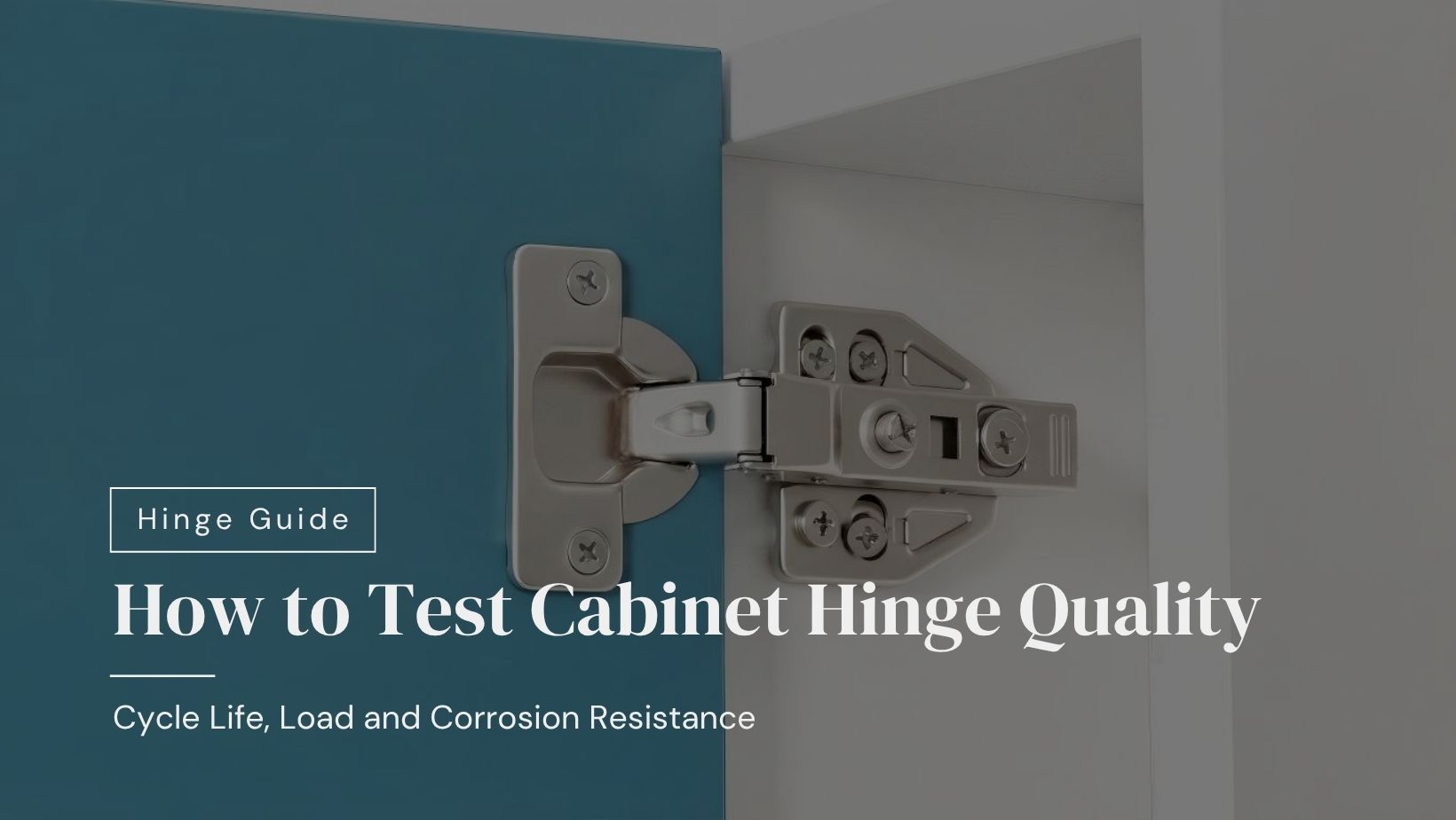
Hydraulic vs Mechanical Soft-Close Cabinet Hinges

Hydraulic vs Mechanical Soft-Close Cabinet Hinges Explained
Soft-close cabinet hinges are designed to prevent doors from slamming and create a quieter, more controlled closing movement.
However, buyers frequently encounter terms such as:
- Hydraulic hinge
- Mechanical hinge
- Hydraulic soft-close hinge
- Spring hinge
- Damped concealed hinge
These terms are not always used consistently.
In many modern soft-close concealed hinges, the system contains both:
- A mechanical spring, which provides the closing force
- A hydraulic damper, which controls the closing speed
Therefore, “hydraulic versus mechanical” is not always a strict either-or comparison. Buyers should evaluate the complete closing mechanism instead of relying only on the product name.
Quick Answer: What Is the Difference?
A hydraulic soft-close hinge uses a fluid-based damper to slow the cabinet door during the final part of its closing movement.
A mechanical self-closing hinge uses a spring to pull the door closed but may not include controlled damping. Some products use friction-based mechanical components to reduce closing speed, but their design and performance vary.
In a common high-quality soft-close hinge:
- The mechanical spring pulls the door toward the cabinet.
- The hydraulic damper resists rapid movement.
- The door closes slowly and quietly.
The spring creates the closing force; the damper controls that force.
1. How Does a Cabinet Hinge Close?
A concealed cabinet hinge normally contains several interacting components:
- Hinge cup
- Hinge arm
- Linkage mechanism
- Spring
- Pivot points
- Mounting plate
- Optional damping system
When the door moves toward the closed position, the spring helps pull it against the cabinet.
Without a damper, the spring may cause the door to close quickly. With a correctly designed damper, the closing speed is reduced before the door reaches the cabinet body.
2. What Is a Hydraulic Soft-Close Hinge?

A hydraulic soft-close hinge contains a damper that uses fluid resistance to control the door’s closing movement.
As the door approaches the cabinet, the damper piston moves through a fluid-filled chamber. The controlled fluid movement creates resistance and slows the door.
The exact internal construction differs between manufacturers.
Main Characteristics
- Controlled closing speed
- Reduced door slamming
- Quieter operation
- Smoother final movement
- More premium user experience
A hydraulic damper does not normally pull the door closed by itself. The hinge spring and linkage still provide the mechanical closing force.
3. What Is a Mechanical Cabinet Hinge?

The term “mechanical hinge” can describe several products.
Spring-Only Self-Closing Hinge
This hinge uses a spring to pull the door into the closed position.
It provides self-closing action but does not necessarily provide soft close. The door may still close quickly or make an impact sound.
Friction-Based Closing System
Some products use friction, mechanical braking or other non-fluid components to control movement.
Performance depends heavily on the design and manufacturing quality. “Mechanical soft close” is not a single standardized mechanism.
Standard Concealed Hinge
A conventional concealed hinge may provide smooth movement and adjustment but have no dedicated soft-close damper.
Because the term is broad, buyers should ask the supplier to explain the actual closing mechanism.
4. Hydraulic Damper vs Spring-Only Hinge
|
Feature |
Hydraulic-Damped Hinge |
Spring-Only Hinge |
|
Closing force |
Mechanical spring |
Mechanical spring |
|
Speed control |
Hydraulic damper |
Usually no dedicated damper |
|
Closing movement |
Controlled |
Faster |
|
Slam reduction |
High when correctly specified |
Limited |
|
Noise control |
Better |
Standard |
|
User experience |
Premium |
Basic |
|
Mechanism complexity |
Higher |
Lower |
|
Typical application |
Modern and premium cabinets |
Economy or basic furniture |
This comparison applies to typical product structures. Actual performance depends on hinge design, door specifications and installation quality.
5. Hydraulic vs Friction-Based Mechanical Damping
|
Feature |
Hydraulic Damping |
Mechanical or Friction Damping |
|
Resistance source |
Controlled fluid movement |
Friction or mechanical braking |
|
Closing feel |
Often smooth and progressive |
Depends strongly on design |
|
Consistency |
Can be highly consistent |
Varies by mechanism |
|
Temperature sensitivity |
Fluid viscosity may be affected |
Usually less fluid-related sensitivity |
|
Leakage risk |
Possible if seals fail |
No hydraulic-fluid leakage |
|
Wear points |
Seals, piston and mechanism |
Friction and contact components |
|
Market availability |
Common in quality soft-close hinges |
Product-dependent |
Neither technology should be judged only by its name. Cycle testing and complete door testing provide more useful evidence of performance.
6. Advantages of Hydraulic Soft-Close Hinges
Controlled Closing
The damper reduces closing speed before the door reaches the cabinet body.
Reduced Noise
Controlled movement helps prevent impact noise, making it suitable for:
- Kitchens
- Bedrooms
- Hotels
- Apartments
- Offices
Better Protection
Reduced impact may help protect:
- Cabinet doors
- Cabinet bodies
- Fixing points
- Items stored inside the cabinet
Premium User Experience
A smooth and quiet closing movement can improve the perceived quality of the entire cabinet.
Suitable for Frequent Use
When correctly specified and tested, hydraulic soft-close hinges can support frequently used cabinet applications.
Service life still depends on product quality, door load, installation and environment.
7. Limitations to Consider
Damper Quality Varies
Two hinges described as “hydraulic” may provide very different performance.
Important factors include:
- Seal quality
- Damper construction
- Fluid stability
- Manufacturing consistency
- Activation point
- Cycle durability
Door Weight Affects Performance
A damper designed for a standard door may behave differently on a very light or heavy door.
A light door may close too slowly or fail to complete the movement. A heavy door may close too quickly if damping resistance is insufficient.
Temperature May Influence Closing Speed
Hydraulic-fluid viscosity can change with temperature.
In colder conditions, some dampers may operate more slowly. In warmer conditions, resistance may decrease.
The degree of change depends on damper design and fluid quality.
Failed Dampers Usually Require Replacement
A sealed damper should not normally be opened or repaired on-site. If it leaks or loses resistance, the hinge or damper module is generally replaced.
8. Does Every Hinge Need a Soft-Close Damper?
Not always.
Some cabinet systems use a soft-close hinge at every position. Other systems use damped and non-damped hinges together.
The correct configuration depends on:
- Door height and width
- Door weight
- Number of hinges
- Damper strength
- Desired closing speed
- Manufacturer’s instructions
Using too much damping may prevent a light door from closing completely. Using too little damping may allow a heavy door to close too quickly.
Sample testing is essential before mass production.
9. Integrated vs Add-On Soft Close
Integrated Soft-Close Hinge
The damper is built into the hinge.
Advantages may include:
- Cleaner appearance
- Fewer separate components
- Convenient installation
- Coordinated hinge movement
Add-On Damper
The damper is installed as a separate component or attached to a compatible hinge.
Advantages may include:
- Retrofitting certain cabinet systems
- Replacing the damper separately
- Adding soft close only where required
Compatibility must be confirmed. An add-on damper should not be attached to a hinge unless the system is designed for it.
10. Adjustable and Switchable Soft Close
Some hinges allow users or installers to:
- Activate or deactivate the damper
- Select different damping levels
- Adjust closing behavior
This can be useful when the same hinge system is used for doors with different dimensions or weights.
However, not every soft-close hinge is adjustable. A visible switch may only turn the damper on or off rather than provide continuous speed adjustment.
Check the technical specification instead of assuming the function.
11. How to Evaluate Soft-Close Performance
Closing Consistency
Test whether multiple doors close at a similar speed.
Activation Angle
Observe when the damping action begins. The damper should engage reliably without creating abrupt movement.
Complete Closing
The door should reach the fully closed position without remaining partially open.
Noise
Listen for:
- Impact sounds
- Clicking
- Grinding
- Spring noise
- Damper noise
Temperature Performance
For projects exposed to significant temperature changes, test the hinge under conditions close to the actual installation environment.
Cycle Durability
Ask for cycle-test information and verify:
- Test load
- Door dimensions
- Number of cycles
- Acceptance criteria
- Whether soft-close performance was checked after testing
A cycle number without test conditions provides limited purchasing value.
12. How to Choose the Right Soft-Close Hinge
Confirm the Door Specifications
Provide the supplier with:
- Door height
- Door width
- Door thickness
- Door weight
- Door material
Confirm the Cabinet Construction
Determine whether the cabinet is:
- Frameless
- Face-frame
- Full overlay
- Half overlay
- Inset
Select the Correct Opening Angle
Standard cabinets often use an opening angle around 105°–110°, while special cabinets may require wider or restricted opening.
Review the Adjustment System
Premium installations may benefit from:
- Height adjustment
- Side adjustment
- Depth adjustment
- Clip-on connection
Check the Damping Configuration
Confirm:
- Integrated or add-on damper
- Damper quantity
- Activation switch
- Adjustment capability
- Recommended door-weight range
Request Samples
Test the hinge on the actual cabinet door rather than evaluating it only by hand.
The performance of a loose hinge may differ from its performance after installation.
13. Applications
Kitchen Cabinets
Hydraulic soft-close hinges are widely used to improve noise control and everyday operation.
Bathroom Vanities
Soft-close performance is valuable, but corrosion resistance and humidity exposure must also be considered.
Wardrobes
Large wardrobe doors require careful matching of hinge quantity, damper strength and door weight.
Hotel Projects
Quiet closing can improve the guest experience. Project buyers should also evaluate consistency and replacement availability.
Apartment Projects
Standardized soft-close systems can improve cabinet value while simplifying installation and maintenance.
Office Furniture
Controlled closing helps reduce repeated impact noise in shared working environments.
14. Common Buying Mistakes
Assuming Every Hydraulic Hinge Has the Same Quality
The word “hydraulic” does not confirm durability, consistency or suitable damping strength.
Confusing Self-Closing With Soft Closing
A spring can pull a door closed without slowing it down.
Ignoring Door Weight
The same damper may behave differently on light and heavy doors.
Testing the Hinge Without a Door
A loose-hinge demonstration cannot accurately reproduce the real closing movement.
Using Too Many or Too Few Dampers
The wrong damping quantity can cause slamming or incomplete closing.
Evaluating Only the Initial Performance
A hinge may feel smooth when new but lose damping performance after repeated use.
Ignoring Replacement Compatibility
For project orders, confirm whether replacement hinges and mounting plates will remain compatible.
Buyer’s Soft-Close Hinge Checklist
Before ordering, confirm:
- Actual closing mechanism
- Integrated or separate damper
- Door-weight recommendation
- Required number of hinges
- Required number of dampers
- Opening angle
- Overlay configuration
- Mounting-plate compatibility
- Adjustment directions
- Soft-close activation point
- Temperature performance
- Cycle-test conditions
- Corrosion-resistance requirement
- Replacement availability
- OEM and packaging requirements
Frequently Asked Questions
Are soft-close hinges hydraulic?
Many soft-close concealed hinges use hydraulic dampers, but they also contain mechanical springs and linkages. The complete hinge is therefore an integrated mechanical and damping system.
What is the difference between self-closing and soft-closing hinges?
A self-closing hinge uses spring force to pull the door closed. A soft-closing hinge adds controlled resistance to reduce the closing speed and prevent slamming.
Are hydraulic cabinet hinges better?
A well-designed hydraulic damper can provide smooth and controlled closing. However, performance depends on damper quality, door weight, hinge design and installation—not simply the word “hydraulic.”
Can a hydraulic soft-close hinge leak?
A damaged or low-quality damper may leak. A leaking sealed damper normally requires hinge or damper replacement.
Why does a soft-close door close too slowly?
Possible causes include excessive damping, a door that is too light, cold operating conditions, hinge misalignment or too many damped hinges.
Why does a soft-close door still slam?
Possible causes include an inactive or damaged damper, insufficient damping, excessive door weight or incorrect hinge quantity.
Can soft-close speed be adjusted?
Some hinge systems provide damping adjustment or an activation switch, while others have a fixed setting. Check the product specification.
Can I mix soft-close and standard hinges?
Some manufacturers permit a combination of damped and non-damped hinges. Follow the specified configuration and test it on the actual door.
How should soft-close hinges be tested?
Install them on a representative cabinet door and evaluate closing speed, noise, complete closure, consistency, alignment and performance after repeated cycling.
Conclusion
“Hydraulic versus mechanical” does not fully describe how modern soft-close cabinet hinges work.
In a typical soft-close system:
- The mechanical spring provides closing force
- The hinge linkage controls door movement
- The hydraulic damper reduces closing speed
A spring-only hinge may be self-closing without being soft-closing. A hydraulic damper may provide controlled movement, but its performance depends on design quality and correct matching with the cabinet door.
For cabinet manufacturers and project buyers, the best selection method is to evaluate:
- Door specifications
- Cabinet construction
- Damping strength
- Closing consistency
- Cycle durability
- Temperature behavior
- Component compatibility
The final decision should be based on complete installed performance rather than product terminology alone.
Related Haits Product Categories
How Many Hinges Does a Cabinet Door Need?
How to Install Cabinet Hinges