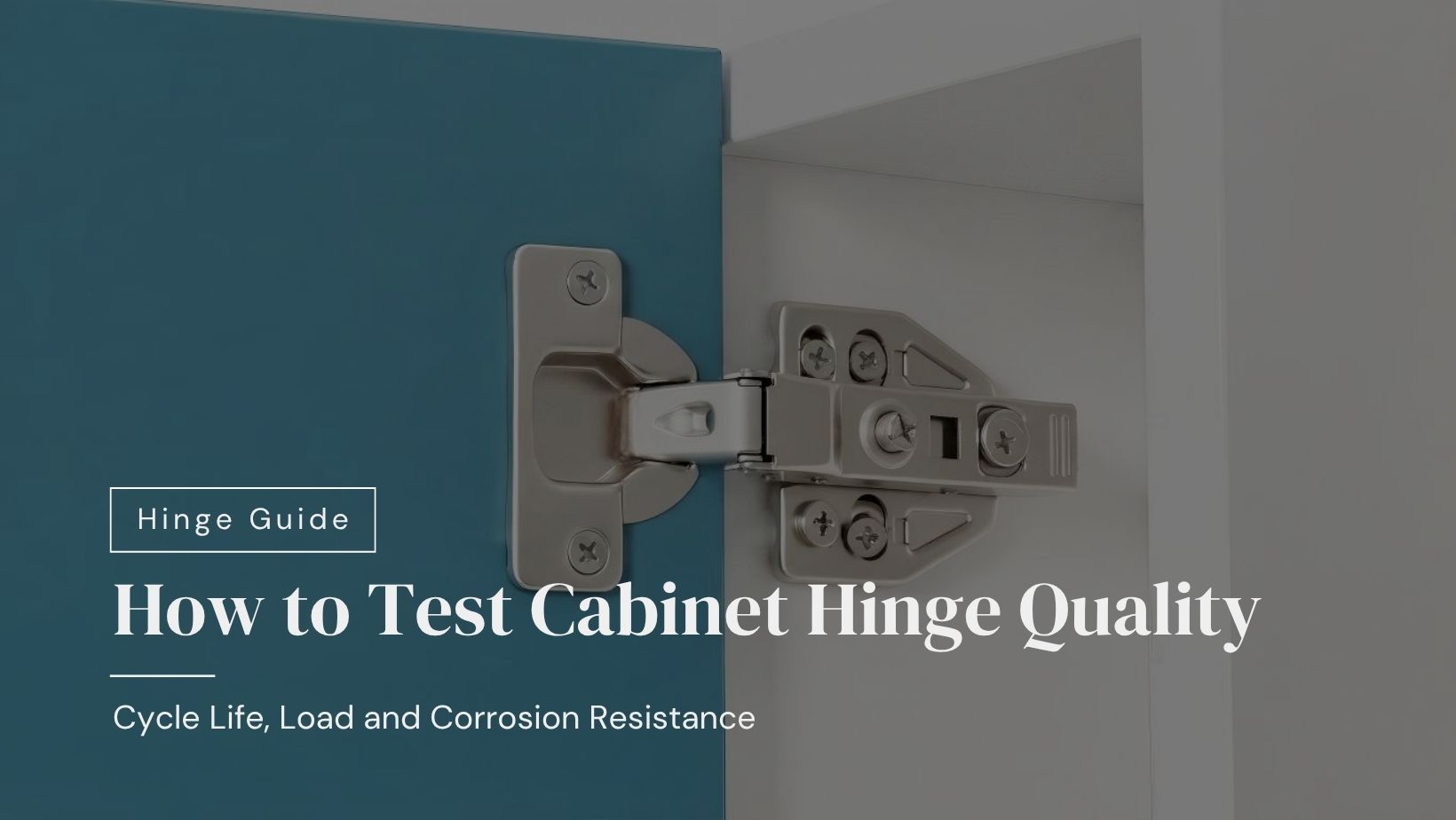
35mm Cabinet Hinges Explained

35mm Cabinet Hinges Explained: A Practical Guide for Cabinet Manufacturers
If you manufacture kitchen cabinets, bathroom vanities or wardrobes, you have probably encountered the term “35mm cabinet hinge.”
But what exactly does 35mm mean?
Does it refer to the hinge size, drilling hole, mounting plate or opening angle?
For cabinet manufacturers and project buyers, understanding this specification is important because incorrect hinge drilling or selection can result in:
- Poor door alignment
- Installation difficulties
- Incorrect overlay
- Door interference
- Reduced hinge performance
This guide explains what a 35mm cabinet hinge is, how the hinge cup works, what should be considered during drilling and how to select the right hinge for different cabinet applications.
1. What Is a 35mm Cabinet Hinge?
A 35mm cabinet hinge normally refers to a concealed hinge with a hinge cup approximately 35mm in diameter.
The circular hinge cup is recessed into the back of the cabinet door.
It forms one of the main structural connections between the cabinet door and hinge mechanism.
The 35mm dimension refers primarily to the cup diameter — not the overall hinge size.
This is an important distinction.
2. Why Is 35mm So Common?
The 35mm hinge cup has become widely used in modern cabinet manufacturing because it provides a practical balance between:
- Compact size
- Structural support
- Adjustment capability
- Manufacturing efficiency
- Compatibility with many cabinet applications
It is commonly found in:
- Kitchen cabinets
- Bathroom vanities
- Wardrobes
- Closets
- Storage cabinets
- Residential furniture
For cabinet factories, standardized drilling also helps improve production efficiency.
3. Understanding the Main Parts of a 35mm Concealed Hinge

A typical concealed hinge system consists of several components.
Hinge Cup
Installed into the cabinet door.
Typical cup diameter:
35mm
Hinge Arm
Connects the hinge cup to the mounting plate and controls door movement.
Mounting Plate
Installed on the cabinet side panel or cabinet structure.
Spring Mechanism
Controls hinge movement and keeps the door in the required position.
Damper
On soft-close models, a damping mechanism slows the final closing movement.
Understanding these components makes hinge selection much easier.
4. Does a 35mm Cup Mean All 35mm Hinges Are the Same?
No.
This is one of the most important points for professional buyers.
Two hinges may both use a 35mm cup, but their functions can be completely different.
For example, 35mm hinges may differ in:
- Full overlay / half overlay / inset
- Opening angle
- Clip-on / slide-on mounting
- Soft close / standard closing
- Adjustment capability
- Mounting plate height
- Door thickness compatibility
- Hinge arm geometry
Therefore:
35mm describes the cup diameter, not the complete hinge specification.
This sentence is worth highlighting on the webpage because it is highly useful for both buyers and AI-generated answers.
5. Understanding 35mm Hinge Cup Drilling
The hinge cup requires a circular recess to be drilled into the back of the cabinet door.
However, professional cabinet manufacturers should not determine the complete drilling pattern based only on the 35mm diameter.
Several dimensions matter:
- Cup diameter
- Cup depth
- Distance from door edge
- Screw-hole position
- Door thickness
- Hinge model
The correct drilling dimensions should always follow the technical drawing of the specific hinge model.
6. Why the Distance From the Door Edge Matters
The position of the hinge cup affects how the cabinet door sits relative to the cabinet body.
If the cup is drilled too close to or too far from the edge, it may affect:
- Door overlay
- Opening movement
- Door clearance
- Adjustment range
For mass production, cabinet factories should therefore standardize drilling according to the selected hinge specification before starting production.
7. Full Overlay, Half Overlay and Inset 35mm Hinges
The same 35mm cup format can be used with different door configurations.
Full Overlay

The cabinet door covers most or all of the cabinet side panel.
Commonly used in modern frameless kitchen cabinets.
Half Overlay

Two doors may share the same cabinet partition.
Each door covers part of the panel.
Inset

The cabinet door sits inside the cabinet opening rather than covering the side panel.
These configurations require different hinge geometries.
So when purchasing, simply saying:
“I need a 35mm hinge”
is not enough.
8. 35mm Soft Close Cabinet Hinges
One of the most common modern configurations is:
35mm Concealed Soft Close Cabinet Hinge
The integrated damping mechanism slows the door during the final stage of closing.
This provides:
- Quieter operation
- Reduced door impact
- Better user experience
- Premium cabinet positioning
It is particularly suitable for:
- Kitchen cabinets
- Bathroom vanities
- Apartments
- Hotels
- Premium residential projects
9. What Opening Angle Should You Choose?
The hinge cup diameter and opening angle are two different specifications.
A 35mm hinge may be available with different opening angles.
Common examples include:
|
Opening Angle |
Typical Application |
|
Around 90°–95° |
Restricted opening applications |
|
Around 105°–110° |
Standard kitchen cabinets |
|
165° or similar wide angle |
Wide-opening applications |
For standard kitchen cabinets, approximately 110° is a common choice.
However, special cabinets may require a different opening angle.
10. Clip-On or Slide-On?
35mm concealed hinges can also use different mounting systems.
Clip-On
The hinge connects quickly to the mounting plate.
Advantages:
- Faster installation
- Easier door removal
- Convenient maintenance
Slide-On
The hinge arm slides onto the mounting plate and is secured in position.
Advantages:
- Simple construction
- Reliable connection
- Cost-effective
The choice depends on production efficiency, cabinet positioning and project requirements.
11. How Many 35mm Hinges Does a Cabinet Door Need?
There is no universal number.
The correct quantity depends on:
- Door height
- Door width
- Door weight
- Door material
- Hinge capacity
- Usage frequency
For example, a small lightweight cabinet door may require fewer hinges than a tall, heavy wardrobe door.
For large-scale projects, the hinge quantity should be confirmed according to the door specification and hinge manufacturer's technical recommendation.
This is safer than applying a single rule to every cabinet door.
12. 35mm Hinges for Different Cabinet Applications
|
Application |
Typical Requirement |
|
Kitchen Cabinet |
35mm soft close concealed hinge |
|
Bathroom Vanity |
Soft close + corrosion consideration |
|
Wardrobe |
Adjustable concealed hinge |
|
Hotel Joinery |
Durability + maintenance efficiency |
|
Apartment Project |
Performance + cost balance |
|
Premium Cabinetry |
Clip-on + soft close + adjustment |
13. What Should Cabinet Manufacturers Check Before Ordering?
A professional hinge inquiry should contain more information than simply “35mm hinge.”
Before ordering, confirm:
- Cup diameter: 35mm
- Door configuration: Full / Half / Inset
- Opening angle
- Soft close or standard
- Clip-on or slide-on
- Door thickness
- Door material
- Mounting plate requirement
- Adjustment requirement
- Required quantity
- Project or production application
For large orders, sample testing before mass production is strongly recommended.
14. Example of a Better Hinge Inquiry
Instead of writing:
We need 35mm cabinet hinges.
A professional buyer can specify:
We require a 35mm cup, full-overlay, 110° clip-on soft-close concealed hinge for kitchen cabinet doors. Please advise the suitable mounting plate and drilling dimensions.
This provides the supplier with much more useful information and reduces the risk of selecting the wrong product.
Common Mistakes When Selecting 35mm Cabinet Hinges
Mistake 1: Assuming All 35mm Hinges Are Interchangeable
They are not.
Cup diameter is only one specification.
Mistake 2: Ignoring Overlay Type
Full overlay, half overlay and inset require different hinge configurations.
Mistake 3: Drilling Before Confirming the Hinge Model
Always confirm the technical drawing first.
Mistake 4: Ignoring the Mounting Plate
The hinge and mounting plate work as a system.
Mistake 5: Choosing Only by Unit Price
Installation efficiency, durability and maintenance should also be considered.
Frequently Asked Questions
What does 35mm mean on a cabinet hinge?
It generally refers to the diameter of the circular hinge cup installed into the back of the cabinet door.
Are all 35mm cabinet hinges interchangeable?
No. Hinges with the same cup diameter may have different overlay configurations, opening angles, mounting systems and soft-close functions.
What size hole do I need for a 35mm hinge?
The hinge cup requires a 35mm-class recess, but the exact drilling depth, edge distance and fixing-hole pattern should follow the technical drawing for the specific hinge.
Is 35mm the standard size for kitchen cabinet hinges?
35mm concealed hinges are widely used in modern kitchen cabinet manufacturing, although the complete specification still depends on the cabinet design.
Can a 35mm hinge be soft close?
Yes. Many 35mm concealed hinges incorporate soft-close damping.
Can 35mm hinges be used for inset doors?
Yes, provided the hinge geometry and mounting configuration are designed for inset applications.
Conclusion
The 35mm concealed cabinet hinge is one of the most widely used hinge formats in modern cabinet manufacturing.
However, the 35mm dimension tells only part of the story.
Professional buyers should also consider:
Overlay + Opening Angle + Closing Function + Mounting System + Door Specification + Mounting Plate
Selecting these parameters correctly helps improve:
- Installation accuracy
- Production efficiency
- Cabinet performance
- Long-term reliability
For cabinet manufacturers and project contractors, understanding the complete hinge system is far more important than selecting a hinge based only on cup diameter.
Related Haits Products
Full Overlay vs Half Overlay vs Inset Cabinet Hinges
Clip-On vs Slide-On Cabinet Hinges