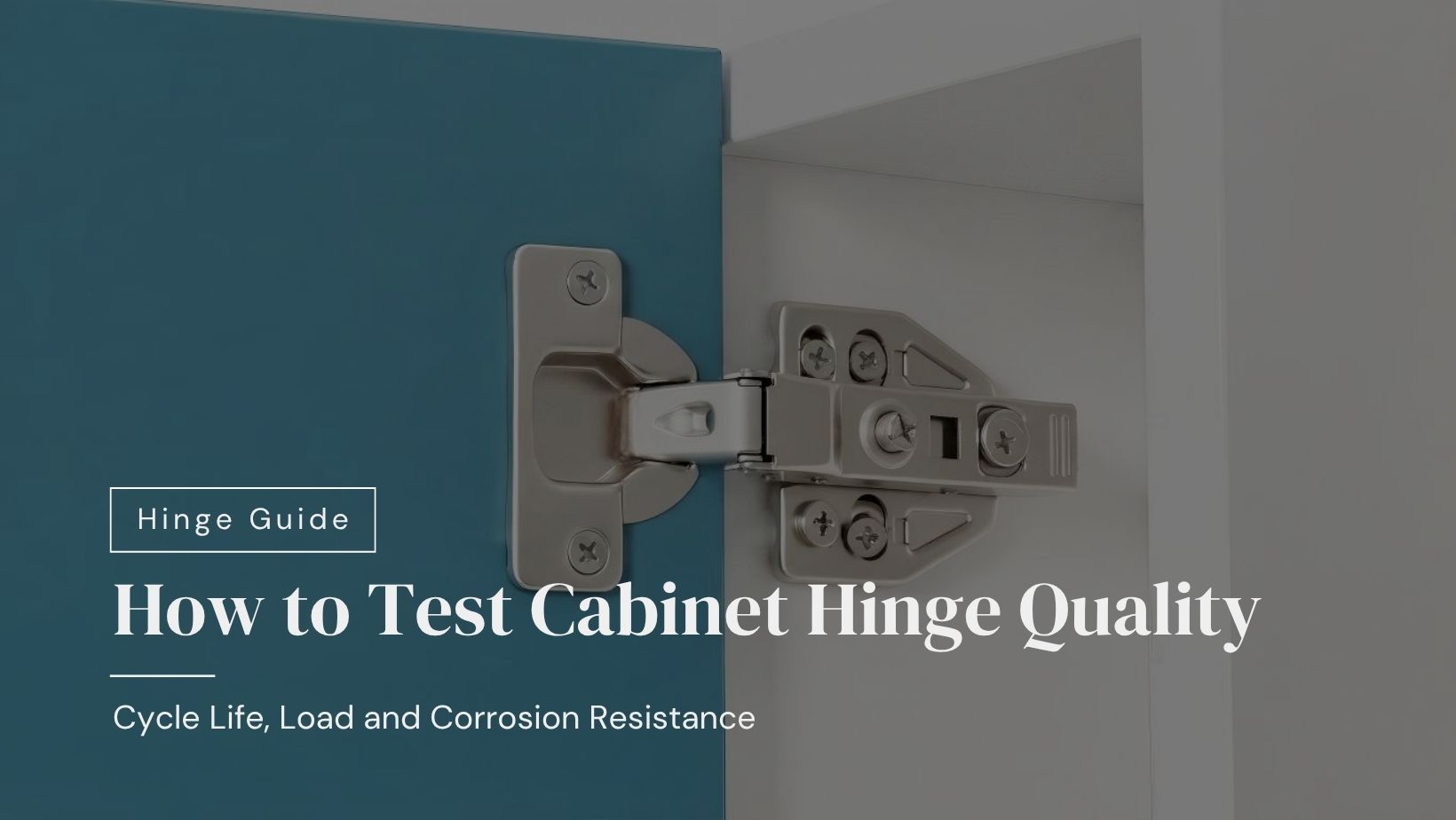
Clip-On vs Slide-On Cabinet Hinges

Clip-On vs Slide-On Cabinet Hinges: Which Is Better for Cabinet Manufacturing?
When selecting concealed hinges for kitchen cabinets, bathroom vanities or other cabinetry, one common decision is whether to use clip-on hinges or slide-on hinges.
Both systems can provide reliable cabinet door movement, but they differ significantly in installation method, assembly efficiency, maintenance convenience and cost.
For an individual cabinet, these differences may seem small. But for a cabinet manufacturer producing thousands of doors or a joinery contractor managing a large residential or hospitality project, the choice can directly affect production efficiency, installation time and long-term maintenance.
This guide explains the differences between clip-on and slide-on cabinet hinges and how to choose the right system for your application.
1. What Is a Clip-On Cabinet Hinge?

A clip-on cabinet hinge uses a quick-release mechanism to connect the hinge arm to the mounting plate.
Instead of tightening a screw every time the door is installed or removed, the installer can attach the hinge to the mounting plate using the clipping mechanism.
The main advantages are:
- Fast installation
- Easy door removal
- Convenient adjustment
- Reduced assembly time
- Easier maintenance
Because of these advantages, clip-on hinges are widely used in modern cabinet manufacturing.
2. What Is a Slide-On Cabinet Hinge?

A slide-on hinge uses a more traditional connection between the hinge arm and mounting plate.
During installation, the hinge arm slides onto the mounting plate and is then secured in position.
The design is relatively simple and can provide a reliable connection at a competitive cost.
Typical advantages include:
- Simple construction
- Reliable connection
- Competitive cost
- Suitable for standard cabinet applications
Slide-on hinges remain practical for projects where quick removal is not a major requirement.
3. Clip-On vs Slide-On Hinges: Key Differences

|
Feature |
Clip-On Hinge |
Slide-On Hinge |
|
Installation |
Quick clip connection |
Slide and secure |
|
Door Removal |
Very easy |
Requires more work |
|
Assembly Efficiency |
Higher |
Standard |
|
Maintenance |
Easier |
More time required |
|
Adjustment Convenience |
High |
Standard |
|
Initial Hardware Cost |
Usually higher |
Usually lower |
|
Mass Production |
Excellent |
Good |
|
Project Maintenance |
Excellent |
Good |
The correct choice therefore depends on more than the unit price of the hinge.
4. Installation Efficiency
Installation efficiency is one of the biggest differences between the two systems.
Clip-On Hinges
With a clip-on system, the cabinet door can be attached to the cabinet relatively quickly.
For a manufacturer producing a large number of cabinets, saving even a small amount of installation time on each door can become significant across an entire production run.
Clip-on systems can therefore be particularly valuable for:
- High-volume cabinet factories
- Modular kitchen manufacturers
- RTA cabinet manufacturers
- Large residential projects
Slide-On Hinges
Slide-on hinges require a more conventional mounting process.
For smaller production quantities or applications where doors rarely need to be removed, the additional installation time may not be a major concern.
5. Which Is Easier to Maintain?
Maintenance is another important consideration, particularly for hotel, apartment and commercial fit-out projects.
Imagine a hotel project where a cabinet door needs to be replaced.
With a clip-on hinge, maintenance personnel can remove the door more conveniently while leaving the mounting plate attached to the cabinet.
This can simplify:
- Door replacement
- Cabinet adjustment
- On-site maintenance
- Hardware inspection
For projects containing hundreds or thousands of cabinet doors, maintenance efficiency can become an important part of the hardware specification.
6. Which Is Better for Cabinet Manufacturing?
For high-volume cabinet manufacturing, clip-on hinges generally provide an advantage because they support faster assembly and easier adjustment.
However, this does not mean that slide-on hinges are inferior.
The decision should consider:
Production volume
Large production volume → Clip-On may provide greater efficiency
Lower volume → Either system may be suitable
Cabinet positioning
Premium cabinet → Clip-On often preferred
Economy cabinet → Slide-On may provide better cost control
Maintenance requirements
Frequent installation/removal → Clip-On
Permanent standard installation → Slide-On can be sufficient
7. Don't Compare Only the Hinge Price
This is particularly important for professional buyers.
Suppose a clip-on hinge costs slightly more than a slide-on hinge.
Looking only at the purchase price may suggest that the slide-on system is cheaper.
But manufacturers should also consider:
Hardware Cost + Assembly Labor + Adjustment Time + Maintenance Cost
This provides a better picture of the actual cost of the hinge system.
For high-volume manufacturing, a hinge that improves installation efficiency can potentially offset part of its higher purchase cost.
8. What About Soft Close?
Both clip-on and slide-on hinges can be available with soft-close functionality depending on the hinge design.
Therefore, buyers should not confuse:
Installation system
with
Closing function.
“Clip-on” describes how the hinge connects to its mounting plate.
“Soft close” describes how the door behaves during closing.
A hinge can therefore be:
- Clip-on + soft close
- Clip-on + standard closing
- Slide-on + soft close
- Slide-on + standard closing
This distinction is particularly useful when preparing cabinet hardware specifications.
9. What About Full Overlay, Half Overlay and Inset?
Clip-on and slide-on are also different from the door overlay configuration.
Depending on the product series, concealed hinges may be designed for:
- Full overlay
- Half overlay
- Inset applications
Therefore, when ordering cabinet hinges, buyers should specify several parameters rather than simply requesting a “clip-on hinge.”
A professional inquiry should include:
Hinge type + Overlay + Opening angle + Soft close requirement + Door specification
For example:
35mm cup, full overlay, 110°, clip-on soft close concealed hinge.
This greatly reduces misunderstanding between buyers and suppliers.
10. Which Hinge Is Better for Different Applications?
|
Application |
Suggested Direction |
|
High-volume kitchen cabinet factory |
Clip-On |
|
Premium kitchen cabinet |
Clip-On Soft Close |
|
Bathroom vanity production |
Clip-On Soft Close |
|
Cost-sensitive furniture |
Slide-On |
|
Hotel joinery project |
Clip-On Soft Close |
|
Apartment project |
Depends on specification & budget |
|
Replacement-friendly project |
Clip-On |
These are general selection principles. The final choice should always be based on the actual door design, usage frequency and project specification.
11. What Should Project Contractors Consider?
For joinery contractors and fit-out companies, the lowest initial hardware price does not always result in the lowest project cost.
Consider:
- Number of cabinet doors
- Installation labor
- Adjustment time
- Replacement requirements
- Spare parts availability
- Maintenance after project handover
For a large hotel or apartment project, these factors can be more important than a small difference in hinge unit price.
12. What Should Buyers Check Before Ordering?
Before placing an order, confirm:
- Cabinet construction
- Door material
- Door thickness
- Door dimensions and weight
- 35mm cup requirement
- Full / half / inset overlay
- Opening angle
- Soft close requirement
- Clip-on or slide-on mounting
- Mounting plate specification
- Adjustment requirements
- Quantity and project schedule
For large projects, sample testing before mass production is also recommended.
Frequently Asked Questions
What is the main difference between clip-on and slide-on cabinet hinges?
The main difference is how the hinge connects to the mounting plate. Clip-on hinges use a quick-release mechanism, while slide-on hinges use a more conventional slide-and-secure connection.
Are clip-on hinges better than slide-on hinges?
Not in every application. Clip-on hinges provide advantages in installation efficiency and maintenance, while slide-on hinges can be an economical and reliable solution for standard applications.
Are clip-on hinges more expensive?
They may have a higher unit cost depending on design and specification. However, professional buyers should also consider assembly labor and maintenance costs.
Can clip-on hinges be soft close?
Yes. Clip-on concealed hinges can incorporate soft-close mechanisms.
Which hinge is better for a kitchen cabinet factory?
For high-volume modern kitchen cabinet production, clip-on soft-close hinges are often attractive because of their installation efficiency and premium user experience.
Which system is better for hotel and apartment projects?
Clip-on systems can be advantageous where installation efficiency, adjustment and future maintenance are important. The final decision should still follow the project's technical specification and budget.
Conclusion
The choice between clip-on and slide-on cabinet hinges should not be based on unit price alone.
Slide-on hinges remain a practical solution for standard and cost-sensitive applications.
Clip-on hinges, on the other hand, can provide significant advantages in:
- Production efficiency
- Installation convenience
- Door adjustment
- Maintenance
- Replacement
For cabinet manufacturers producing at scale and joinery contractors working on large projects, these operational benefits can make clip-on hinges an attractive long-term solution.
The best hinge is ultimately the one that matches the cabinet design, production process, project requirements and total cost of ownership.
Related Haits Products
35mm Cabinet Hinges Explained
Soft Close Cabinet Hinges Explained