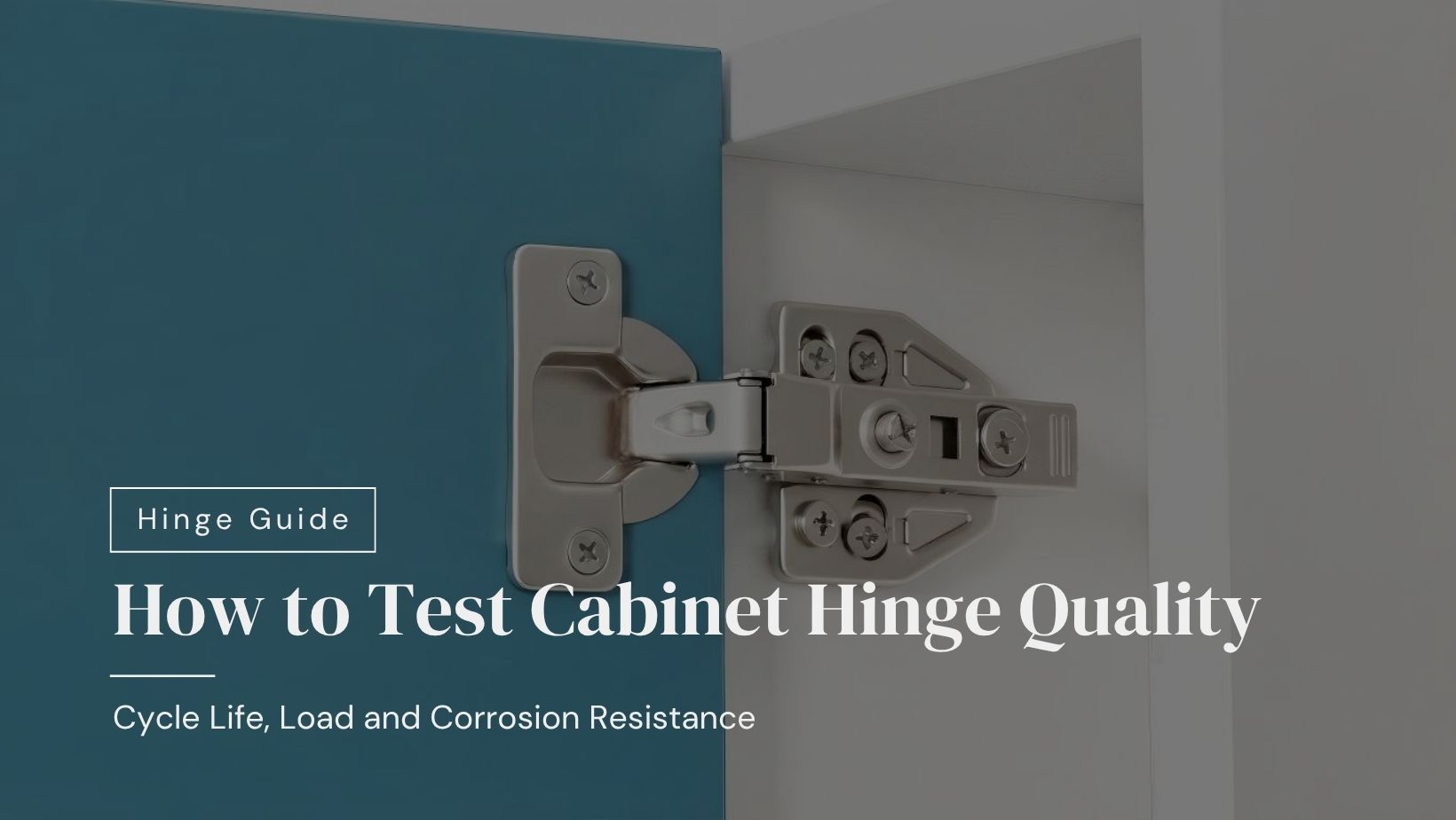
What Are Cabinet Hinges

What Are Cabinet Hinges? A Complete Guide for Cabinet Manufacturers
Cabinet hinges are one of the most important hardware components in modern furniture and cabinetry. Although they are small parts, hinges directly affect cabinet functionality, durability and user experience.
A high-quality cabinet hinge allows doors to:
- Open and close smoothly
- Stay properly aligned
- Operate quietly
- Maintain long-term performance
For kitchen cabinet manufacturers, bathroom vanity producers, joinery contractors and project suppliers, choosing the right cabinet hinge is essential for producing reliable and high-quality cabinets.
This guide explains what cabinet hinges are, how they work, the different types available and how to select the right solution.
1. What Is a Cabinet Hinge?
A cabinet hinge is a mechanical component that connects the cabinet door to the cabinet frame or cabinet box.
Its main functions include:
- Supporting the weight of the door
- Allowing controlled opening and closing
- Maintaining door alignment
- Providing adjustment options
- Improving cabinet appearance
Modern concealed cabinet hinges are widely used in kitchens, bathrooms, wardrobes and furniture because they provide a clean appearance and reliable performance.
2. How Do Cabinet Hinges Work?
A concealed cabinet hinge normally consists of several key components:
Hinge Cup
The hinge cup is installed inside a drilled hole on the cabinet door.
The most common size is:
35mm hinge cup
Hinge Arm
The hinge arm connects the door to the mounting plate and controls the opening movement.
Mounting Plate
The mounting plate attaches the hinge to the cabinet side panel.
Different mounting designs include:
- Clip-on
- Slide-on
- Fixed mounting
Adjustment System


Modern cabinet hinges usually provide adjustment functions:
- Side adjustment (Left & Right)
- Depth adjustment (In & Out)
- Height adjustment (Up & Down)
These adjustments allow installers to achieve perfect door alignment.
3. Why Are Concealed Cabinet Hinges Popular?
Traditional hinges are visible from the outside of the cabinet.
Concealed hinges are hidden when the cabinet door is closed.
Advantages include:
Clean Appearance
The cabinet exterior remains simple and modern.
Easy Adjustment
Installers can fine-tune door position after installation.
Better Design Flexibility
Suitable for:
- Modern kitchens
- Luxury furniture
- Custom cabinetry
- Commercial projects
4. Common Types of Cabinet Hinges
1. Soft Close Cabinet Hinges

Soft close hinges include an integrated damping mechanism that controls the closing movement.
Benefits:
- Quiet closing
- Prevents door slamming
- Improves user experience
- Extends cabinet life
Applications:
- Kitchen cabinets
- Bathroom vanities
- Wardrobes
- Residential projects
Soft close hinges have become a standard feature in many premium cabinet applications.
2. Clip-On Cabinet Hinges

Clip-on hinges allow quick installation and removal.
- Advantages:
- Faster assembly
- Easier maintenance
- Improved production efficiency
They are widely used by cabinet manufacturers because they reduce installation time.
3. Slide-On Cabinet Hinges

Slide-on hinges are installed by sliding the hinge onto the mounting plate and securing it with screws.
Advantages:
- Reliable connection
- Cost-effective
- Suitable for mass production
4. 3D Adjustable Cabinet Hinges

3D adjustable hinges allow adjustment in three directions:
- Left and right
- Up and down
- In and Out
Advantages:
- Faster installation adjustment
- Better door alignment
- Suitable for premium cabinetry
5. Wide Opening Cabinet Hinges

Some cabinet applications require wider opening angles.
Examples:
- Corner cabinets
- Large doors
- Special storage solutions
Common opening angles include:
- 95°
- 110°
- 165°
5. Understanding Cabinet Hinge Opening Angles
The opening angle determines how far the cabinet door can open.
|
Opening Angle |
Application |
|
95° |
Standard cabinets |
|
110° |
Most kitchen cabinets |
|
165° |
Wide opening applications |
For most residential kitchens, 110° hinges are the most common choice.
6. Cabinet Hinge Overlay Types

Choosing the correct hinge depends on the cabinet construction.
Full Overlay Hinge
The cabinet door covers almost the entire cabinet side.
Common for:
- Modern kitchens
- Frameless cabinets
Half Overlay Hinge
Two doors share one cabinet side panel.
Common for:
- Traditional cabinet designs
Inset Hinge
The cabinet door sits inside the cabinet frame.
Common for:
- Classic furniture designs
- Premium cabinetry
7. How to Choose Cabinet Hinges?
Cabinet manufacturers should consider:
1. Cabinet Design
Is it:
- Frameless cabinet?
- Face frame cabinet?
- Inset cabinet?
2. Door Weight
Heavier doors require stronger hinge systems.
Consider:
- Door size
- Door material
- Door thickness
3. Opening Requirements
Choose according to:
- Standard opening
- Wide opening
- Corner cabinet requirements
4. User Experience
Consider:
- Soft close requirement
- Noise control
- Adjustment convenience
5. Project Requirements
For hotels, apartments and commercial projects, reliability and consistency are critical.
8. Cabinet Hinges for Different Applications
|
Application |
Recommended Hinge |
|
Kitchen Cabinet |
Soft Close 110° Hinge |
|
Bathroom Vanity |
Soft Close Hinge |
|
Wardrobe |
Adjustable Concealed Hinge |
|
Luxury Furniture |
3D Adjustable Hinge |
|
Commercial Projects |
Durable Soft Close Hinge |
9. Common Cabinet Hinge Problems
Door Misalignment
Possible causes:
- Incorrect installation
- Poor adjustment
- Incorrect hinge selection
Door Cannot Close Properly
Possible causes:
- Wrong overlay type
- Cabinet deformation
- Incorrect mounting position
Hinge Noise
Possible causes:
- Poor quality mechanism
- Lack of durability testing
10. Why Quality Matters for Cabinet Manufacturers
For manufacturers, hinges are not just hardware components.
They affect:
- Cabinet quality perception
- Customer satisfaction
- After-sales cost
- Project reputation
A reliable hinge supplier should provide:
- Stable quality
- Consistent production
- Testing capability
- OEM support
- Technical assistance
Frequently Asked Questions
What is the most common cabinet hinge?
The most common cabinet hinge is the concealed 35mm cup hinge, especially soft close 110° hinges used in kitchen cabinets.
What size are cabinet hinge cups?
The standard cabinet hinge cup size is usually 35mm diameter.
Are soft close hinges better than regular hinges?
Soft close hinges provide a quieter and smoother closing experience and are preferred for modern residential and premium projects.
What is a 3D adjustable cabinet hinge?
A 3D adjustable hinge allows adjustment in three directions, helping installers achieve accurate door alignment.
How long do cabinet hinges last?
The service life depends on material quality, manufacturing precision, installation and testing standards.
Conclusion
Cabinet hinges are essential components that determine cabinet performance, appearance and durability.
For modern kitchens, bathrooms and furniture projects, concealed soft close hinges have become the preferred solution because they combine functionality, convenience and premium design.
By understanding hinge types, opening angles, overlay options and adjustment systems, cabinet manufacturers and project contractors can select the right hinge solution for each application.
A professional cabinet hardware supplier can help customers choose reliable hinge systems that improve cabinet quality and reduce long-term maintenance costs.
Related Haits Products


How to Choose Cabinet Hinges